Press release: 13 May 2014

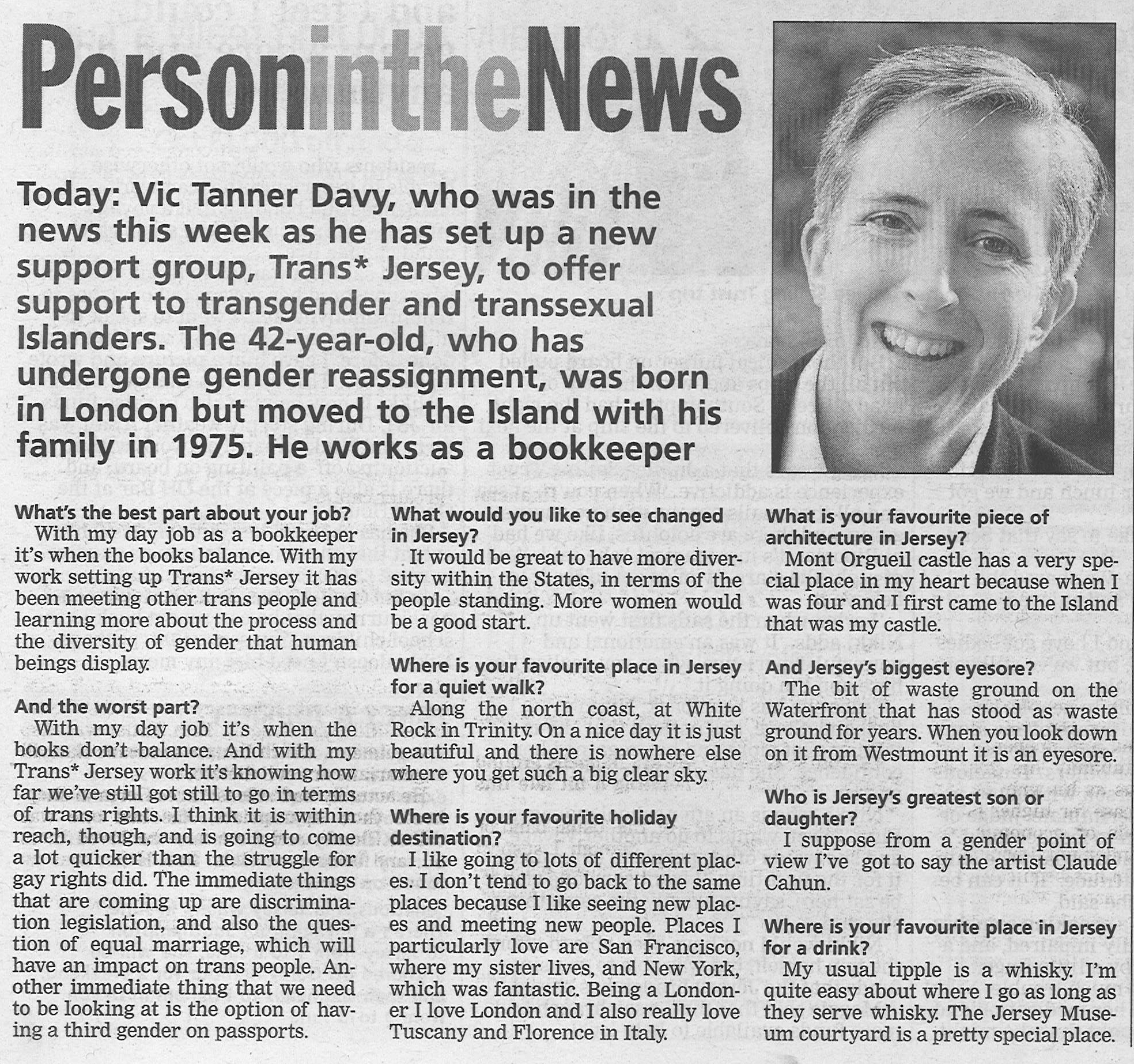
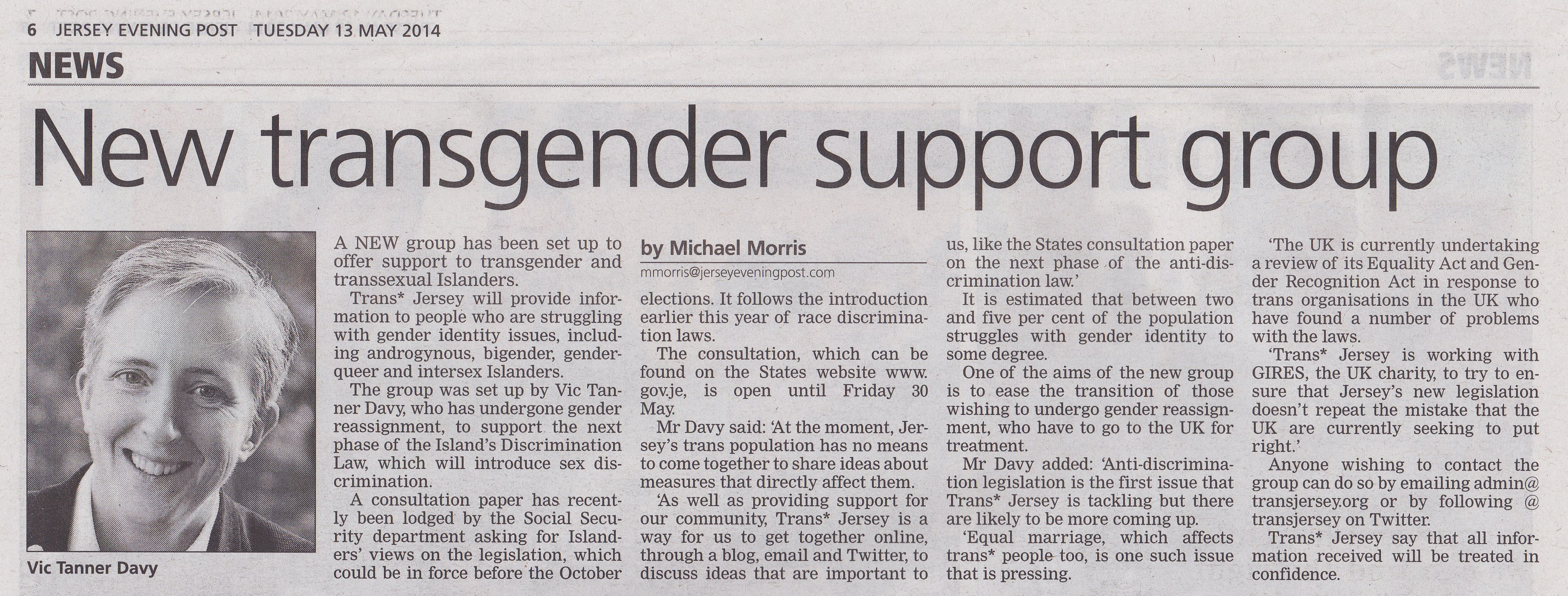
A new group offering support and information to transgender, transsexual, androgynous, genderqueer, bigender and intersex islanders in Jersey is starting up.

Trans* Jersey is the idea of the Jersey novelist, Vic Tanner Davy, and grew from his own experience of transitioning in Jersey and the need to respond to the States of Jersey’s consultation paper on sex discrimination legislation, the next phase in the island’s anti-discrimination laws.

(Note: “Trans*” with an asterisk encompasses transsexual, transgender, androgynous, intersex, genderqueer and bigender people, whereas “trans” only refers to transgender and transssexual people.)

The transgender population in Jersey is very small. It is estimated that about 2-5% of any given population suffers from some degree of gender dysphoria and, of them, only 1 in 12,000 natal males and 1 in 34,000 natal females will transition, although these numbers are increasing. This equates to a population in Jersey of about 2,000 to 5,000 people who might consider themselves androgynous, genderqueer or bigender and only a handful of transgender/transsexual people (i.e. those who have undergone gender reassignment), of which Mr Davy is one.

Because of the size of the population affected by trans* issues, there is very little support on the island for trans* individuals. Anyone wishing to transition has to go to the UK for the specialist treatment required. Trans* Jersey seeks to bridge that gap by providing information about the process of transitioning for trans* islanders and their healthcare professionals.

“At the moment, Jersey’s trans* population has no means to come together to share ideas about measures that directly affect them. As well as providing support for our community, Trans* Jersey is a way for us to get together online, through a blog, email and Twitter, to discuss issues that are important to us, like the States’ consultation paper on the next phase of the anti-discrimination law,” explains Mr Davy. “Anti-discrimination legislation is the first issue that Trans* Jersey is tackling but there are likely to be more coming up. Equal marriage, which affects trans* people too, is one such issue that is pressing. The UK is currently undertaking a review of its Equality Act and Gender Recognition Act in response to trans* organisations in the UK who have found a number of problems with the legislation. Trans* Jersey is working with GIRES, the UK charity, to try to ensure that Jersey’s new legislation doesn’t repeat the mistakes that the UK are currently seeking to put right.”

Trans* Jersey would like to hear from any trans* islanders before 31 May 2014 when the States of Jersey consultation closes. If you are interested in getting involved or learning more about Trans* Jersey, please email admin@transjersey.org or visit the blog www.transjersey.org or follow @transjersey on Twitter. Trans* Jersey is aware that not all transgender individuals wish to be open about their gender status and therefore all correspondence will be treated in the strictest confidence.

Born Between

20 minute full extended promotional film produced to raise funds for the feature length documentary production. ‘Intersex’ or ‘Variations of Sex Development’ is a topic few people have ever heard of. We reveal the natural factual science and the personal stories of being born between.

Germany makes intersex a birth certificate option

http://youtu.be/p8id0IzR0Io

BBC World TV Impact presenter Rajesh Mirchandani speaks to Sarah Graham, a British intersex woman, and a counsellor about her experiences growing up.

The interview was part of coverage about how Germany has become the first country in Europe to allow babies with characteristics of both sexes to be registered as neither male nor female. From today, parents will be allowed to leave the gender blank on birth certificates. The move is aimed at removing pressure on parents to make quick decisions on the sex of their babies, including whether they might need surgery to determine their gender.

Equal marriage support

Trans* Jersey supports Deputy Sam Mezec’s call for the States of Jersey to pass legislation to legalise same-sex marriage. Trans* Jersey goes further and would support a move for the island to model its law on Scotland’s equal marriage legislation.

We support equal marriage because, as the law currently stands in Jersey, a transman or transwoman in a marriage or civil partnership and wishing to legally transition (by acquiring a gender recognition certificate (“GRC”)) must first obtain a divorce from their spouse. Divorce and re-marriage (via a civil partnership or marriage, depending on which way you are going!) carries with it not just costs but implications for the continuation of legal documents, such as wills, and pension provisions.

This is the only known example where the law requires someone to forgo one right (the right to remain married to their partner) in order to access another (the right to private life afforded by the Gender Recognition Act). This anomaly has led to some transsexual people in the UK deciding not to acquire a GRC, as they argue their marriage vows were for life and they object to the idea that their partner (by remaining with them and true to those vows) would be unfairly treated by dissolving the original bond.

When Scotland was considering equal marriage legislation, James Morton of the Equality Network and Scottish Transgender Alliance released this video explaining why equal marriage matters to trans and intersex people. Trans* Jersey agrees with the points he made.

When England introduced the Marriage (Same Sex Couples) Act 2013, they got it wrong. They included what has come to be called the Spousal Veto, a clause that allows spouses of transgender people to effectively stop them from legally transitioning (i.e. acquiring a GRC). Sarah Brown, the LibDem politician and trans* activist, explains why this is a problem here.

When Scotland passed its legislation, the Marriage and Civil Partnership (Scotland) Act 2014, they got it right. They removed the need for transgender people to dissolve their marriage before be able to acquire a GRC; they have enabled people to have gender-neutral marriage ceremonies; and they secured the removal of the spousal veto.

An explanation from the Equality Network on what Scotland’s recently passed equal marriage bill will mean for trans and intersex people.

The Equality Network is a Scottish lesbian, gay, bisexual and transgender (LGBT) equality charity: http://www.equality-network.org

Intersex: advocate Hida Viloria in interview

http://youtu.be/DmDP238ltHk

Jeff 4 Justice interviews Organization Intersex International chairperson Hida Viloria about being intersex. Relaxed interview with loads of information about intersex life. Contains some adult themes.

At http://www.intersexualite.org/ you can learn more about Organization Intersex International. At http://www.hidaviloria.com/ you can follow the work of Hida Viloria.

Note: intersex conditions are not the same as being transgender or transsexual.

Middle Sexes: Redefining He and She

Documentary by award-winning filmmaker Antony Thomas (HBO’s Celibacy), Middle Sexes: Redefining He and She, sensitively explores the controversial subject of the blurring of gender as well as the serious social and family problems – even dangers – often faced by those whose gender may fall somewhere in between male and female. Narrated by noted author Gore Vidal and filmed in the United States, Europe, Asia, and South America, Middle Sexes examines the ways different societies and cultures handle the blurring of gender, sexual identity and sexual orientation. Through interviews with transgender, intersexual and bisexual men and women, as well as experts from the scientific and academic communities, the film considers the entire spectrum of sexual behavior, personal identity and lifestyles among people of different backgrounds and cultures. From this, a theme of tolerance and appreciation of diversity emerges in the film.

Along with thought-provoking personal experiences of transsexuals, intersexuals, transvestites and their partners and families, Middle Sexes: Redefining He and She interviews scientists,anthropologists and psychologists who offer ground-breaking research on the biological and cultural influences on gender identity and sexuality. Researchers cite examples from the natural world, where species display a wide range of sexual variation, and point out that humans show more diversity than the strict male-female dichotomy.

Choosing M or F

Count the number of times in a week you are asked to choose between M or F. It will surprise you. At work, you may have to choose every time you use the toilet facilities; when you are shopping for clothes, you will be asked to choose the men’s or women’s department; when you select a book or movie, entertainment is segregated into sections such as “chick-lit” or “movies for men”; and, when you fill out a form, the place you are applying to will want to know, too (if for no other reason than to be able to address you formally).

Here’s a list of some the things that we came up with that ask us to choose:

  • Public toilets
  • Changing rooms
  • Hospital wards
  • Airport security
  • School
  • Prison
  • Military service
  • Public transport (in some countries)
  • Religious observance
  • Sports teams
  • Exercise classes
  • Application forms
  • Shopping centres (especially clothing stores)
  • Advertising/products
  • Books/movies

toiletsignFor many of the things we’ve listed a strong argument can be made for a unisex approach to them. Take shopping for instance, stores could be organised by the item you wish to purchase, instead of effectively divided into two stores, M and F. Imagine M&S having departments simply called underwear, shirts, trousers, skirts, jumpers, etc. Would this be a problem? You need a pair of jeans, so you browse through all their jeans and you come out with a pair of jeans that fit and that you are pleased with. Does it matter that the designer of the jeans had a particular gender in mind when they created them?

Ah, but what about the changing rooms, though? The same argument that we use against those who think that making trans* people use toilet facilities that match their biological sex, rather than their preferred gender, is relevant here: when did you last see a person naked in a department store changing room (or public toilet)? It never happens. Unisex facilities put nobody at any greater risk than segregated facilities and, with appropriate doors/curtains on the cubicles, are entirely private.

So, why is it a choice? Why have we come up with the idea that men and women should be kept separate? Honestly, Trans* Jersey struggles to answer this question. We don’t really know. We can only guess that it comes two parts: a) it is a hang over from when the church’s idea of sin governed our morality and contraceptives were not widely available. In the interest of stopping boys and girls doing what boys and girls might do, segregation was strictly maintained. b) it makes it easier for the marketing men. They can generalise how women respond to products, as distinct from men, and target their marketing accordingly.

The other question that is relevant here is: why did we decide that we should separate the human population into only two groups? And why pick this particular facet of humanity? Why not hair colour, or eye colour, or whether we can dance or not, or whether we like Marmite or not? There aren’t two genders. We know that gender is a spectrum. There aren’t even two sexes. 1 in 100 births are intersex (see here for more information). Like so many facets of humanity, trying to put us all into two categories doesn’t work. Right or left handed? What about ambidextrous people?

Categorising us all into two genders is unnecessary and arbitrary but it persists. We wish it didn’t. It would make living in the middle easier. So, until such time as society gets over its hang up with labeling us one or the other, we are forced to choose every day. Count the number of times.

What makes a (wo)man a (wo)man?

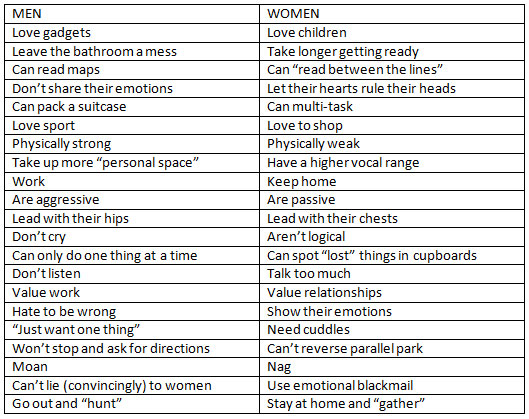
We all know what makes a (wo)man a (wo)man, right? Make a list of the things that differentiate men from women. What are the clues you look for when you meet someone for the first time?

Here’s our list, which is not in any way exhaustive:

Men-v-WomenAn anthropologist will tell you that evolution over thousands of years is responsible for many of these differences and a biologist will tell you that the hormones bathing the brain are responsible for the others. But that cannot be the whole story as one look at your list will tell you that for every trait you put down you know a man or woman who does not conform to the stereotype, and it doesn’t make them feel or appear less manly or womanly.

There are many, many men who work in artistic or caring professions; who have hobbies that do not correspond to the stereotypical man; who enjoy talking; who take responsibility for their children and for making a home; and, who show/share their emotions willingly. But they still feel like men. Equally, there are many women who work in tough, hostile environments; who are capable of fixing an engine; who enjoy their own company; who don’t get broody at the sight of a pushchair; and, who are not in touch with their emotions. But they still feel like women.

So, maybe there is no universal checklist that we can use to say that is a man and this is a woman. But we know what a man is and what a woman is, don’t we? We use that definition every day without thinking about it. So, is there a default within all of us as to what defines a man or a woman? We believe we can get closer to an answer by agreeing that there is no universal set of criteria. Our education, experiences, and society shape our definition of men and women, and it is subtly different for each individual. We know that is a man and this is a woman because a lifetime of influences has taught us that, when we receive those particular signals from the people we meet, it means man or woman. We only think about it when we come into contact with someone who blurs the gender divide. And, even then, we don’t think about it too hard.

Within a single culture, both sender and receiver will know “the rules”, ie. the accepted gender presentation for a man or a woman. This means that a sender can consciously elect to blur their gender. Done successfully, the receiver will not be aware that they are meeting someone whose biological sex is not aligned with their presented gender. But this also means that the receiver can get it wrong if their experience is not the same as the sender’s. Receivers from another culture may be particularly bad a guessing the right gender based on appearance.

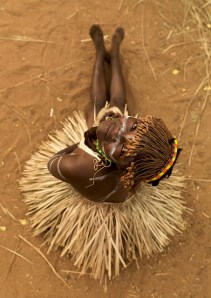
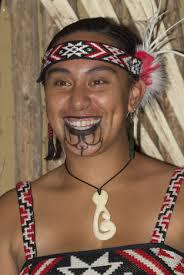
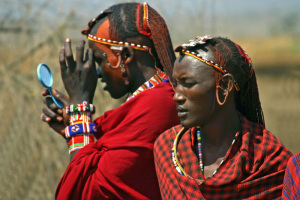
Can you guess the gender of the following people? It’s not so easy when you don’t know the cultural gender clues and begs the question of why society gets so steamed up when individuals digress gender boundaries. Visit another culture and you won’t have a clue whether the person you are meeting is genderqueer.

mursi-womantharaka-girlmaorimasai-warriorsAnswers: Mursi woman (Ethiopia), Tharaka woman (Kenya), Maori woman (New Zealand), Maasai men (Kenya/Tanzania)