
The infographic below takes some headline figures from well-respected sources and uses them to estimate the size of Jersey’s trans, trans* and intersex populations.
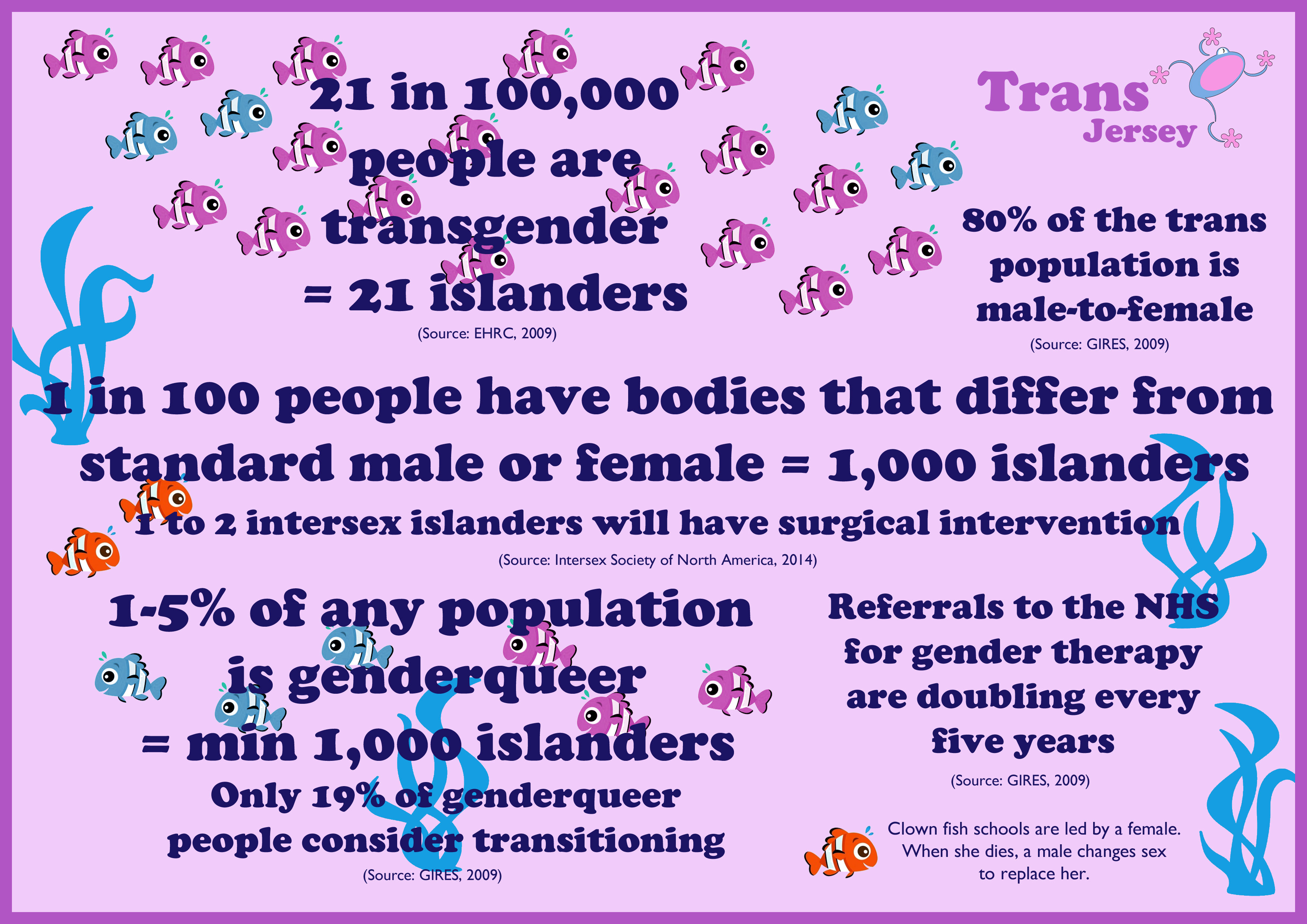
The infographic below takes some headline figures from well-respected sources and uses them to estimate the size of Jersey’s trans, trans* and intersex populations.

Why civil partnerships do not make for equal marriage
For those who think that they were made some kind of promise by the gay community that civil partnerships would be enough to ensure equality, I can confirm that no such promise was made by the trans community who have always known that civil partnerships do not provide true equality. As Jersey law stands, a person in a marriage or civil partnership who undergoes gender reassignment whilst still in that union is severely discriminated against.
A key part of a transgender person’s journey is acquiring their gender recognition certificate (”GRC”) after two years of living as their true gender. It is a legal document that means for all purposes you are the gender you present. It enables a trans person to have all legal documents amended, including their birth certificate. It also provides a degree of privacy protection for the trans person because it is an offence under the Gender Recogntion (Jersey) Law to “out” someone in possession of a GRC, for example, when giving an employment reference.
Under current Jersey legislation, at the point at which a trans person in a marriage or civil partnership applies for their GRC, they are forced to dissolve their union. Having done so, they are then expected to re-make their union using the vehicle appropriate to their gender and the gender of their spouse. The choice for transgender individuals in this situation is clear: either, do not apply for your GRC and continue having your official documents “out” you; or, change your official documents at the cost of losing your legal ties to your family.
Anyone who has been through a divorce will know that not only are there costs involved, emotional and financial, but also that a divorce immediately stops the continuation of joint arrangements, such as pension provisions, insurance policies and wills, some of which cannot be re-started without severe penalty. And, if the union has produced children, the situation gets even more complicated. I think that all sides of the marriage argument would agree that nobody should be forced to go through a divorce.
 In 2006, the International Commission of Jurists and the International Service for Human Rights developed a set of international legal principles on the application of international law to human rights violations based on sexual orientation and gender identity. These were called the Yogyakarta Principles and, whilst not adopted as an international standard, are cited by UN bodies and national courts, and many governments have made them a guiding tool for defining their policies in the matter. The European Commissioner for Human Rights has endorsed the Yogyakarta Principles, in particular principle number 3, and considers them an important tool for identifying the obligations of states to respect, protect and fulfil the human rights of all persons, regardless of their gender identity.
Yogyakarta Principle number 3 states that, “Each person’s self-defined sexual orientation and gender identity is integral to their personality and is one of the most basic aspects of self-determination, dignity and freedom… No status, such as marriage or parenthood, may be invoked as such to prevent the legal recognition of a person’s gender identity.”
Whilst legislation exists that gives opposite-sex couples a different piece of paper from same-sex couples, there will always be an inequality at the heart of the island’s laws. Jersey is proudly bringing in the first piece of anti-discrimination legislation later this year and, yet, enshrined within its laws is a nasty little “gotcha” that discriminates against a person in a marriage or civil partnership who transitions. If Jersey is serious about improving its human rights credentials on the world stage, it needs to adopt the Yogyakarta Principles as an internationally recognised model of best practice and address anomalies within its legislation such as this.
This is why Trans* Jersey is supporting Guernsey’s proposition for a Union Civile that requires all couples, regardless of gender, to wed in a civil ceremony that registers the union for legal purposes. Having done the legal part, couples who then wish to seek a church service aligned to their religious beliefs regarding marriage can do so. This solves the argument over the definition of marriage that exercises religious and secular groups, and it enables a transgender person to acquire their GRC and alter the gender on their Union Civile certificate without having to divorce. It is an elegantly simple solution to the problem and one that we hope Jersey will also propose, debate and pass.

This week Guernsey moved a step closer to equal marriage with a clever proposal for a Union Civile law that would remove religion from laws related to marriage. You can read more about the story here or visit Liberate’s website for more information about the work they have been doing.
 The proposed law would mean that all those who wanted to marry would do so in a civil ceremony. Thus, in one bold stroke, all marriages between two people, irrespective of their sex or gender, would be equal in Guernsey. The ability to legally marry a couple would be removed from religious organisations, which would also remove the knotty question for people of faith as to whether their church should “allow” same-sex marriage.
Under the proposal, there would be nothing to stop a couple celebrating their wedding through a religious service after they had legally tied the knot civilly. Under current EU legislation, there is no means by which a religious organisation could be forced to offer a celebratory service to a same-sex couple if it is against their religious beliefs. This should satisfy the churches that the legislation does not stop them from celebrating marriages as they understand them in the way that they wish.
Trans* Jersey stated that we would be in favour of adopting the Scottish model for same-sex marriage legislation, but this new development from Guernsey is even better. It does away with the UK system of two laws, one for opposite-sex couples and one for same-sex couples, in favour of one law for everyone.
We are in favour of adopting Guernsey’s proposal here in Jersey as it would solve the problem that trans people have when they transition within a marriage. Under Guernsey’s proposal, the marriage stays intact and the transition has no effect on its status. This also resolves the problem, perceived by some, that a person’s transition alters or diminishes the partnership somehow. Under this proposal, there is no alteration of the partnership and, therefore, the spouse has no reason to require a veto to stop their partner’s transition.
Deputy Sam Mezec lodged a proposition with the States of Jersey this week to debate same-sex marriage in July. We will have to wait for more news on what Jersey’s proposed legislation will look like, but Trans* Jersey hopes that it will resemble Guernsey’s forward-thinking and elegantly simple proposal.

Trans* Jersey has now submitted its response to the States of Jersey Social Security Department white paper on law to protect against sex discrimination. All comments received regarding the white paper were incorporated into the response. However, this is not the end of the process. A period of consultation begins now, which Trans* Jersey hopes it will be involved with. We have expressed our interest in doing so. If you have further comments or issues that you want included, please email us.
Trans* Jersey restricted its response to two of the characteristics being considered by the consultation – sex and gender reassignment – that are of most concern to trans* islanders and suggested ways in which the law might be drafted to protect a more diverse, but equally discriminated against, population.
 Summary of key issues arising
The white paper assumes that gender and sex are interchangeable. For most people that may be the case but it is not the case for trans* people. Using a binary model of sex as a protected characteristic by which to assess discrimination presents problems. These are outlined in the full response.
There are a number of misconceptions about what it means to be trans* and, unfortunately, the States of Jersey’s consultation document falls into some common traps. Why these misconceptions are unhelpful is discussed in the full response.
The States of Jersey has looked to the UK Equality Act for guidance on how to shape its anti-discrimination legislation. However, as the recent manifesto presented to the UK government by a number of UK charities that work with the trans* community demonstrates, there are problems with this legislation (and the Gender Recognition Act) that need to be corrected.
Jersey has an opportunity to bring in model legislation that advances the current position of trans* people within British law. Trans* Jersey offers a solution to the problems it sees as arising from the proposals put forward in the white paper in order that Jersey can implement legislation that encompasses the broad spectrum of human gender identity.
What we would like to see
Trans* Jersey is asking for the States of Jersey’s law to protect against sex discrimination to include two things:
To find out more about how we arrived at the above and the background to our thinking on the white paper, you can download our full response here.

Trans* Jersey’s manifesto defines the problems faced by transgender, transsexual, genderqueer, androgynous, bigender and intersex Jersey residents in 2014 and explains what actions we intend to take to address these issues.
 Trans* Jersey believes that the island’s trans population is being patchily served by GPs and the States of Jersey Health and Social Services (“H&SS”) Department. This is due to the lack of clear guidelines for healthcare professionals working with trans patients. Individual clinicians within the H&SS Department are not seen to be at fault and, once the H&SS Department has been accessed, experiences of care have been good to excellent, largely through the efforts of the clinician acting on their own initiative. However, the initial route into healthcare for trans patients is unclear. The evidence suggests that the quality of healthcare provided is also influenced by the tenacity and perseverance of the trans individual being treated.
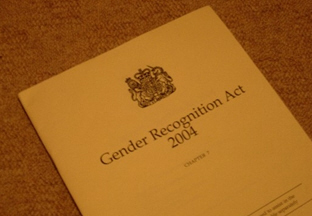 Trans* Jersey supports the calls by trans* organisations in the UK that the process for procuring a gender recognition certificate (“GRC”) needs revision. The Gender Recognition (Jersey) Law 2010 allows for a GRC from a recognised jurisdiction to be passed in the Royal Court. Any revisions that happen to the UK Gender Recognition Act 2004 as a result of the consultation happening with trans* organisations will, therefore, directly affect trans islanders. At present, Jersey has no mechanism by which to issue a GRC. However, this may change if trans* organisations within the UK are successful in calling for the Gender Recognition Act to be scrapped and for the issuance of a GRC to be an administrative process driven by the trans individual.
 Trans* Jersey is committed to ensuring that all States of Jersey legislation that directly affects trans* islanders is scrutinised and responded to on behalf of the Jersey trans* community in order to safeguard our human rights. Trans* Jersey is currently preparing a response to both the States of Jersey consultation on sex discrimination and the imminent debate on equal marriage. Trans* Jersey will also be reviewing all legislation in force to ensure that there are no revisions that need to be called for.
 Trans* Jersey believes that equal marriage legislation is essential to ensure that trans islanders are not discriminated against, and that any equal marriage law introduced in Jersey should not contain the so-called Spousal Veto. Trans islanders who are married or in a civil partnership at the time of their transition have no option currently but to get divorced before they can acquire a full GRC. On the granting of a full GRC, the couple may formalise their partnership again by having another wedding ceremony. This situation is patently in violation of all human rights.
 Trans* Jersey believes that education is the key to many of the issues faced by trans* individuals in society and is therefore committed to providing opportunities and resources to cisgender islanders in order that they can learn more about the trans* population. In the coming months, Trans* Jersey will be seeking conversations with private schools and the States of Jersey Education, Sport and Culture (“ES&C”) Department about including trans* issues within the sex education curriculum.
These are not the only issues faced by trans* individuals in Jersey, but they are the most important ones to be addressed. We are a small group with no financial backing. This manifesto is, therefore, necessarily realistic in its aims. It is not possible to hit all targets at once so we are being selective. Once progress has been made on these issues, we can turn our attention to other areas where reform is needed.
You can download the complete manifesto as a pdf here.
Video from the “Are you an ALLY?” campaign for Health Equity at Mount Sinai Hospital in Canada: http://www.mountsinai.on.ca/about_us/… Explains how you can help trans* individuals when you encounter them.

The following is taken from a paper produced in May 2014 by the UK charity, GIRES. It is a useful summary of the issues facing trans* citizens and the groups working with them for equality.
Introduction
The numbers of transgender people presenting for medical treatment is increasing by 20% pa. This figure rises to 50% for young people. EHRC estimates that 1% of the population fall under the protected characteristic of gender reassignment.
Transgender people are the victims of unequal treatment under the law. This sets a dreadful example and fuels the discriminatory and sometimes violent and abusive treatment experienced by many trans people.
The current government has chosen to ignore a growing cohort of younger people who do not identify with the gender binary. Many such people have no protection under the 2010 Equality Act and have no mechanism to get appropriate ID. In effect they are being excluded from Society.
Surely in 2015 equality and enjoyment of full Human Rights shouldbe an entitlement of all?

A course of action is requested to achieve the following end state:
(a) having no legislation permitting discrimination on the grounds of gender identity or non gender binary identification;
(b) truly equal marriage;
(c) abolition of the 2004 Gender Recognition Act and new processes for gaining appropriate ID;
(d) education for younger people to eliminate prejudice in the longer term; and
(e) new medical treatment models to cope with the rapidly increasing numbers presenting for treatment.
Government must come to realise that people cannot be categorised into neat boxes and its obsession in trying to do so is making life very difficult for many!
A summary of requested actions is given below. [More detail on each section can be found in separate posts]:
1. Legislative revisions [More detail on this can be found here]
Equality Act 2010: Remove any rights to legally discriminate against transgender people. Grant protections to those who do not fit into the gender binary.
Gender Recognition Act 2004: Trans people find the process of having their assertions of gender incongruence checked for truth by the Gender Recognition Panel a degrading and patronising (and also expensive and protracted) process. The Act was introduced to address the lack of same sex marriage in the UK and is no longer relevant, and indeed divisive. Given that gender related discrimination is no longer permitted in the UK, a legal change of gender on birth certificates should be a self driven administrative process.
Marriage (Same Sex Couples) Act 2013: The Spousal Veto must be removed if this remains in the Act when the trans marriage regulations are passed later in 2014. The marriages of couples who were forced to annul and subsequently formed civil partnerships should be reinstated. Government assertions “that the past cannot be rewritten” are hollow given that birth certificates, and soon marriage certificates, can now be altered.
Matrimonial Causes Act 1973: Section 12(h) (non disclosure of gender history) must be withdrawn. Under this provision trans people are singled out for treatment not applied to any other group. Furthermore, as one does not have to disclose (for example) that one is a convicted murderer or married to another) before having sex, why can one be imprisoned for not doing so if one has a trans history?
Application of EU law to pension claimants: Despite very clear and well established superior European Court of Justice case law, the Department of Work and Pensions, supported by some but not all Courts, continues to act unlawfully towards some transgender pension claimants.
2. Non gender binary issues [More detail on this can be found here]
Marriage laws: Gendered language in ceremonies should be optional.
Passports: The introduction of the X marker on passports is long overdue. The conclusion of a recent Passport Office report on this topic was that there is no demand for X markers contradicted the evidence it received.
Birth Certificates: As part of the new provisions following the Gender Recognition Act a mechanism should be introduced to allow the sex classification to be removed or changed or an “X” category added.GIRES encourages direct communication with the appropriate communities.
3. Education [More detail on this can be found here]
It is the experience of GIRES that many in government do not understand the difference between sexual orientation and gender identity. This is vividly demonstrated by married trans people and their spouses “being shoehorned into arrangements for gay and lesbian people” (evidence: Commons Committee Stage, Same Sex Marriage Bill). However, the route to combating transphobia longer term is to introduce awareness training on diversity, early in the education process, in schools.
4. Medical treatment of trans people [More detail on this can be found here]
Despite some recent progress in improved treatment protocols, the growing numbers presenting for medical help are now overwhelming the specialist clinics. Although gender dysphoria is no longer accepted as a psychiatric condition, treatment generally remains under the control of specialist clinics led by psychiatrists. Inappropriate treatment and increasing delays are harming transgender people. New treatment models must be implemented to ensure timely and flexible treatment packages that make best use of the funds available.
Trans* Jersey’s response to the proposals in GIRES’ report
Because so much of Jersey’s transgender and transsexual population’s experience is as a result of having treatment in the UK or acquiring their gender recognition certificate from the UK, these issues affect us, too. Trans* Jersey, therefore, wholly supports the aims and proposals of GIRES and the other trans* organisations working to reform the law in the UK.
To find out more about how Jersey trans* individuals are affected by each of the four proposals listed above, click on the links to more detail where we outline the proposed change in greater depth and explain how we would like to see the States of Jersey tackle these issues.

Equality Act 2010: Jersey is addressing the provisions of this law with its own anti-discrimination legislation. You can find out more about the public consultation process here.
Gender Recognition Act 2004: This Act directly affects trans islanders who wish to apply to the UK for their gender recognition certificate (GRC). Although Jersey has it own Gender Recognition (Jersey) Law 2010, it merely provides for a GRC from another jurisdiction to be registered in the Royal Court. You can find out more about this law here.
Trans* Jersey supports the calls to simplify the process of acquiring a GRC and to retain the protections afforded to trans individuals in possession of a GRC.
Marriage (Same Sex Couples) Act 2013: The Spousal Veto is the most pressing issue raised by the new legislation in England and Wales, and more information can be found about it here.
The Spousal Veto does not exist within Scotland’s legislation and Trans* Jersey are therefore advocating that, when Jersey brings in its own version of the Marriage (Same Sex Couples) Act, it follows the example of Scottish law.
Matrimonial Causes Act 1973: Under Section 12(h) (non disclosure of gender history) of this Act, a marriage can be voided on the grounds that the respondent is a person whose gender at the time of the marriage had become their acquired gender under the Gender Recognition Act 2004. The Act, however, does not state whether a marriage could be voided on the grounds that the spouse is transgender but not in possession of a GRC. There is, therefore, a discrepancy between the way that the law treats trans individuals who hold a GRC and those who do not.
Jersey has followed the UK with the Matrimonial Causes (Jersey) Law 1949, which has similar provisions to the above in paragraphs 18(h) and 18(i). Trans* Jersey would like to see these clauses removed from Jersey law.
 Application of EU law to pension claimants: GIRES explains this issue as follows:
Trans women who have undergone gender reassignment surgery qualify for a Category A retirement pension under the direct effect of European Union Directive 79/7. Well established European Court of Justice (ECJ) case law indicates that once direct effect is established, it cannot be removed by a national law that introduces more burdensome conditions than in the Directive. The direct effect of Directive 79/7 has been set aside by the Department for Work and Pensions (DWP), which will only award a pension at the female pension age if the applicant holds a GRC.
Alas, for married applicants, they must currently divorce before they can receive GRC. This makes the award of a pension dependent on marital status and this is forbidden (on any grounds whatsoever) under Article 4 of the aforementioned Directive. Tribunals are unaware of their legal duty to enforce EU law and have little understanding of how EU law interacts with national law in matters of shared competence. It has not been appreciated that direct effect is by default, a part of national law and must be enforced.
Trans people are not being treated according to the law. Also, DWP is using procedural “initiatives” to delay Tribunal cases to deny justice. One such case had an appeal initiated over three years ago, has been postponed 6 times and “stayed” twice, was heard at the First-tier Tribunal nearly two years ago and has still not delivered a judgment.
Existing law should be enforced. The law firm dealing with such claims will be prepared to brief EHRC on the specific case law that has been set aside. A Judicial Review is being planned to address confidentiality issues related to trans service users of the DWP. A further case is being planned to address the use of domestic law to limit the rights to pensions awarded under EU law. The principle must be established that the law applies to trans people.
Trans* Jersey is currently undertaking research into how trans islanders are being treated with regard to pension provisions.
Trans* Jersey would also add into the legislative areas of concern for trans* people the following:
Sexual Offences Act 2003: Under Section 76 of this Act, a trans* individual can be prosecuted for obtaining sexual intimacy by fraud if they do not first declare their trans* history before intimacy occurs. The case of Chris Wilson is one such example and is explained in more detail here. It should be noted that there is no requirement for murderers, people with a history of domestic violence, soldiers with genitals that have been mutilated in the line of duty, bankrupts, etc to disclose their history before intimacy.
This is a nasty little “gotcha” that Jersey trans* people need to be aware of when dating in the UK. There is no equivalent law in Jersey.
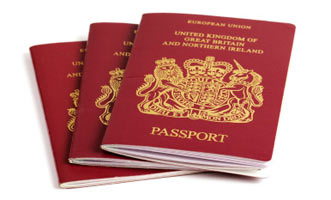
Trans* Jersey supports the proposal that gendered language in marriage ceremonies should be optional and that an X marker on passports and birth certificates should be introduced. Both these issues are most important for genderqueer, androgynous, bigender and intersex individuals.
 The UK charity GIRES offers further explanation of this issue as follows:
Those that are outside the gender binary are not protected under ‘gender reassignment’ as they do not intend to undergo gender reassignment or have any medical treatment.
It is accepted that those with gender dysphoria, who wish to change their social gender role on the basis on non identification with the assigned gender at birth, can do so. Those that do not identify with the birth recorded gender (or the alternative gender) and have no wish to adopt the opposite gender role have no mechanism either to gain protection under the 2010 Equality Act or obtain appropriate ID. Their often ambiguous physical appearance can cause issues when travelling. Passports can be issued to a transitioning person in their non birth recorded gender even without GRC. The Passport Office has the option of the marker “X” to denote other than male or female but refuses to use this despite it being an international convention. Alas a recent Passport Office report ignored the evidence and determined that there was no call for the X marker. The non gendered community are thus excluded from full civil participation.
The 2010 Equality Act “gender reassignment” characteristic should be widened to include those outside the gender binary. The 2004 GRA should be broadened to include an assessment of applicants who wish to have a Birth Certificate reissued with an X (or sex not recorded). Passports should be made available with the X marker irrespective of the Birth Certificate to ensure consistent treatment of all those with “gender dysphoria”.
Trans* Jersey will be responding to the States of Jersey’s consultation on the next phase of the island’s anti-discrimination legislation to ensure that trans* individuals are not excluded from the protections offered by Jersey’s equivalent of the UK’s Equality Act.
Trans* Jersey is currently undertaking research to find out whether Jersey’s passport office have the option to use the X marker as the UK passport office does, and whether it also refuses to do so.
GIRES reports that: Schools do not have proper advice on how to deal with and eliminate transphobic bullying and generally, this is not being addressed. Trans children are suffering as a result. In the new March 2014 Department of Education Guidance into Preventing and Tackling Bullying gender reassignment is mentioned but not as often as other protected categories.
Trans people in schools (pupils, staff, children of trans parents) are more likely to suffer from bullying than any other group.
The Department for Education should ensure that all schools are provided with advice on preventative and responsive action and fully informed about the information and training provided by GIRES, Mermaids and Gendered Intelligence.
Trans* Jersey echoes this call with the same request to the States of Jersey’s Department for Education, Sport and Culture to use the resources provided by trans* groups to educate. In preparation for the new anti-discrimination legislation being passed in Jersey next year, Trans* Jersey is preparing a series of courses aimed at employers, employees, teachers and students dealing with issues affecting trans* individuals.
According to GIRES in the UK, the current Department for Education curriculum for sex and relationship education (published in 2000 and referred to in a Standard Note to MPs earlier this year) includes references to sexual orientation but not to gender reassignment.Gender variant young people are thus denied equal treatment.
Trans* Jersey is currently researching the States of Jersey’s sex education curriculum.
Education about trans* issues is especially important for those working in the public sector where employees often act as gatekeepers to services that trans* individuals need to access, such as the hospital, passport office, parish hall and social security.
GIRES cites this example of where a perceived lack of education about and empathy with trans* issues is a barrier to reporting and prosecuting hate crimes:
The main issue is underreporting of transphobic hate crime due to a fear on the part of trans victims that the Police and other agencies of the Criminal Justice System will not take them seriously. Trans witnesses also fear being “outed” in Court. Hopefully we shall see some improvement following the publication of the updated the CPS Trans Management Guidance authored by GIRES and the proposed revision of the Victims Code.
Trans* Jersey firmly believes in the power of education to change people’s attitudes to and treatment of trans* individuals.
 Trans* Jersey