Pathway to care achieved

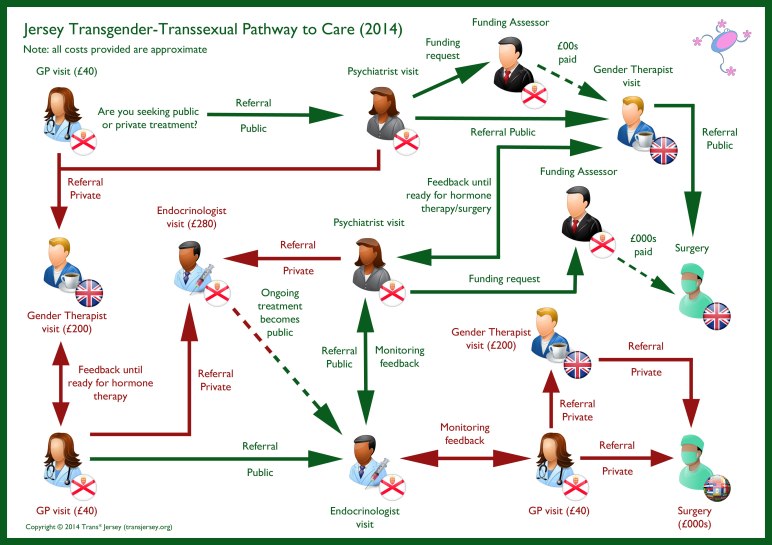
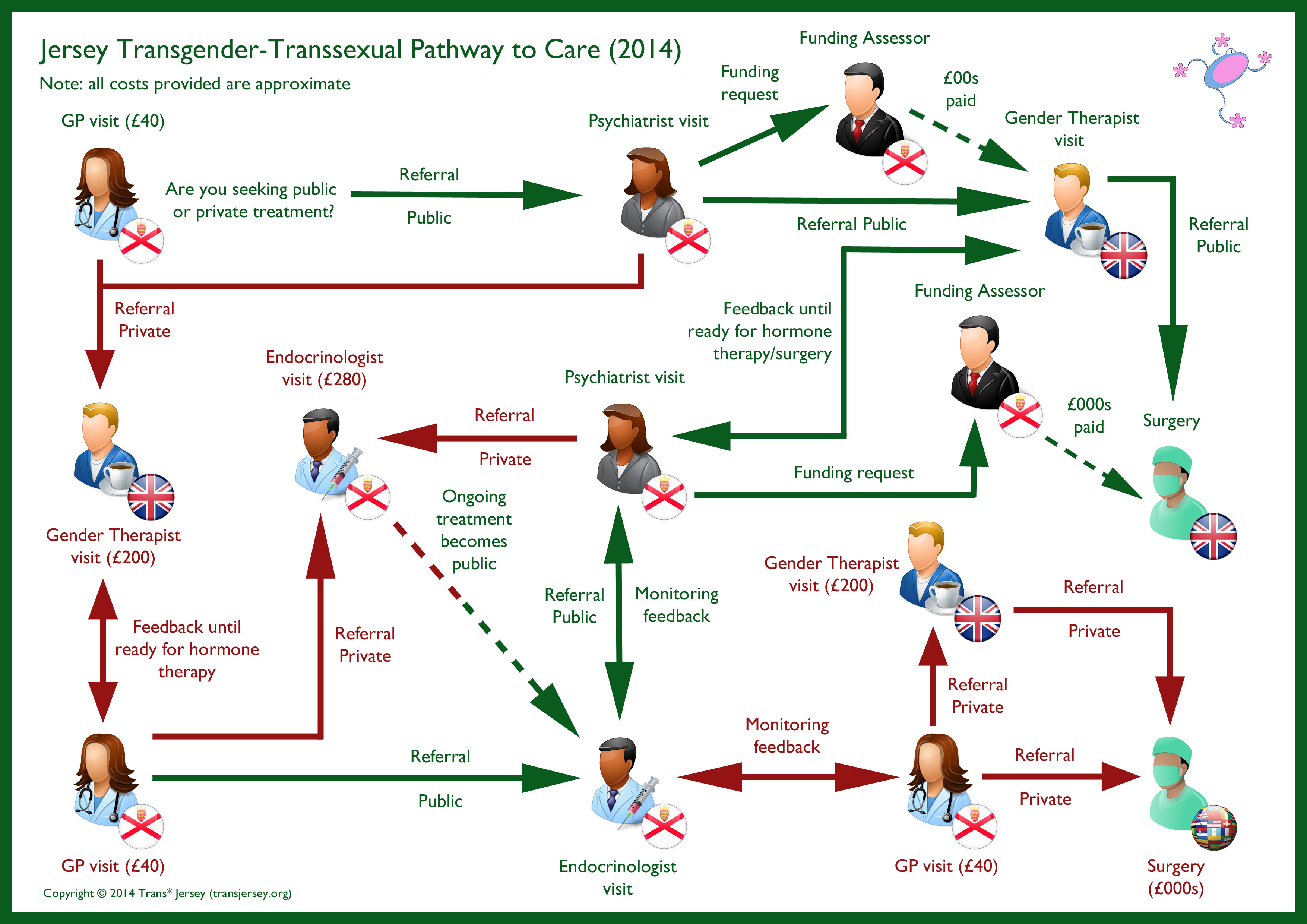
Trans* Jersey met with Helen O’Shea, Managing Director of the General Hospital, and Richard Jouault, Managing Director of Community and Social Services, today. As a result, we have now had the pathway to care for trans* islanders confirmed, and it is as shown.

Trans* Jersey will be working on getting this into a form that can be distributed to all GPs’ surgeries so that, as the first point of contact for trans* people, doctors know who to refer to and can advise their patients on the pathway to care.

This is the first of our 2014 manifesto goals to be realised. We are, therefore, grateful to the States of Jersey’s health service professionals for their openness and time to assist us, and to those trans islanders who shared their experiences of the health service in Jersey and the UK.

System

MtF surgery

All surgery is optional. You should not feel that you have to have surgery to validate your transition from M to F. You should have surgery because you want to have surgery and for no other reason.

Bottom surgery
This refers to genital reconstruction surgery (GRS), ie. a penectomy and orchidectomy to remove the male genitalia and plastic surgery (vaginoplasty, clitoroplasty, labioplasty and repositioning of the urethra) to provide you with a genital appearance that is virtually indistinguishable from natal born women. The phases of the operation are done in one procedure under general anaesthetic and takes about five hours. The Looking Glass Society has a great section on the variety of surgical methods and their advantages and disadvantages.

When considering bottom surgery, manage your expectations. Post-surgery interviews reveal that 98% of transwomen are satisfied with the physical results of their surgery. However, the surgery is irreversible so you need to consider the emotional implications carefully. You will not be able to have children after surgery (unless you make a deposit with a sperm bank first), you may find that your relationship with your partner changes dramatically post-surgery, with potential loss, and genital surgery won’t change how people behave towards you in public life.

There are no surgeons available on the island to undertake this procedure so you will need to go to the UK or abroad if you want GRS. If you are being treated through the NHS, you will be offered a list of approved surgeons to choose from. If you wish to go privately, you can choose from surgeons in private practice all over the world. However, you will need to research the best person for your needs and your budget.

Do your research. Look at the numerous blogs and YouTube videos uploaded by transwomen describing their experiences. Visit some of the forums for transwomen and post questions asking about their experiences. Don’t forget to ask about any emotional reactions to the surgery as well as the physical results. Most transwomen are happy to share this information.

surgeryOther surgery
This comes in several parts. The Looking Glass Society explains the range of surgical options available to transwomen. It is exceedingly rare for any of these procedures to be funded through the health service. If you wish to undergo one of these options, you should be prepared to fund it privately.

You will not be surprised to learn that there are no surgeons with the required skills to perform these operations in the island. You are therefore looking at travel costs again and, because of the complexity of some procedures, several trips to the UK or abroad may be needed.

Facial feminising surgery and rhinoplasty
This refers to plastic surgery to feminise the face and/or remodel the nose. Some transwomen find that, even after HRT, their facial features retain a heaviness that is masculine in appearance and does not allow them to pass as they would like to. Cosmetic surgery can help to alleviate this problem.

Thyroid chondroplasty (tracheal shave)
For transwoman who have a very prominent ‘Adam’s Apple’, this procedure can reduce it by making a small horizontal incision in a natural crease-line on the neck and removing part of the thyroid cartilage.

Augmentation mammoplasty (breast enlargement)
Even after one or two years on HRT, some transwomen are unhappy with the breast growth resulting naturally. They, therefore, consider having implants. There are a number of options available now that are alternatives to silicone so do your research to find out which would suit your requirements best.

Hair transplantation
HRT will thicken the existing hair but many transwomen who transition later in life find that they retain a male pattern hairline. Hair transplantation can be effective in “filling in” the gaps at the front of the hairline to produce a more feminine line.

The same advice applies to these surgeries as for GRS: manage your expectations and do your research thoroughly.

Open letter to all States of Jersey members from Liberate

This is the full version of Liberate‘s excellent letter to all members of the States of Jersey on the subject of Deputy Sam Mézec’s proposition:

I write on behalf of LIBERATE in support of Deputy Sam Mézec’s proposition lodged at the States Greffe on Wednesday 28 May 2014 petitioning the States of Jersey to introduce equal marriage in the Bailiwick of Jersey.

LIBERATE is the first Channel Island charity to support the islands’ Lesbian, Gay, Bisexual, Transgender and Questioning Community (LGBTQ).

Who we are

Liberate is an inclusive Group, which welcomes people irrespective of sexual orientation, gender identity, religious belief, race, gender or disability. We are a local charity and were founded on 15 February 2014 in Guernsey.

Liberate is made up of a virtual rainbow of people from every different gender and sexual identity you could possibly think of. With such a diverse background we can operate on many different levels as we all bring something different to the group.

Our vision

Our vision is simple. We believe in a Fair & Equal society, where everyone is born equal and free, and treated with dignity and respect no matter what their gender, gender identity, sexual orientation, disability, belief or race.

Article 1 of the United Nations Declaration of Human Rights states: “All people are born free & equal in dignity and rights”.

Children do not know racism, sexism, homophobia, biphobia, transphobia, unless they are taught it and government has a responsibility to ensure that it sends a clear message to communities that discrimination in all its forms is not acceptable.

Our purpose

The purpose of Liberate is to educate and inform on a wide range of issues and to support those who identify as LGBTQ, their families and friends.

We campaign to reform some of Guernsey’s policies and laws to ensure that LGBTQ people can enjoy the same freedoms as everyone else in the Bailiwick of Guernsey. We also lend our support to the LGBTQ community in Jersey and are affiliated to Trans*Jersey.

We question social attitudes and behaviours which discriminate against LGBTQ people, and offer advice and help in tackling homophobia, biphobia, transphobia, etc.

Our aims

We will petition and work with government to:

  1. Introduce Equal Marriage Legislation
  2. Give transgender people full access to services to allow them to transition to their gender identity
  3. Introduce anti-discriminatory legislation or an Equality Act which addresses homophobic, biphobic and transphobic hate crime
  4. Reform laws and policies such as income tax legislation to ensure that they are non-discriminatory

Since our website www.liberate.gg was launched we have had over 1,000 signatures in support of equal marriage in the islands. We have also achieved one of our aims in Guernsey of having transgender reassignment surgery funded by the States of Guernsey. We also:

  • Support the local Lesbian, Gay, Bisexual, Transgender and Questioning community, their families, friends and carers through a wide range of initiatives.
  • Educate and inform society through outreach and Public Awareness campaigns.
  • Fight to ensure that everyone is treated fairly and equally under the law, and that no-one is left behind.
  • Challenge discrimination in all its forms in our daily lives, whether it is working in a voluntary capacity for Liberate, at work, socially, etc. We will not be bystanders.
  • Act as Ambassadors for Equality and Diversity in our daily lives.
  • Work with other organisations, charities and non-governmental organisations to promote equality and fairness in our society and facilitate positive change in social policy.
  • Respect the dignity and rights of others at all times, whether we have differences of opinion or belief, or not.

The Free & Equal Campaign

The United Nations Human Rights Commission recently launched its Free & Equal Campaign which is partly aimed at world governments to ensure that they do not actively discriminate through legislation and policy, as well as encouraging the LGBTQ community to speak out and have a voice.

The LGBTQ community have historically been persecuted, tortured and executed[1]. Indeed 81 countries still classify homosexuality as a criminal offence. It is only in recent history that it was decriminalised in our society, and not until the early 1990’s that the World Health Organisation declassified homosexuality as a disease. We hope that you can therefore appreciate how difficult it is for the LGBTQ community to be visible and speak out against social injustice.

Deputy Mézec’s Proposition

Deputy Mézec’s proposition is an important step for Jersey in ensuring that each and every one of its citizens are free and equal in dignity and rights.

Jersey recently made an important step in terms of tackling discrimination with the introduction of its Discrimination Law. We see the introduction of equal marriage in Jersey as a natural progressive step towards that goal. Failure to do so will deny approximately 10% of the population the right to marry, and be totally at odds with Jersey’s current social policy in terms of discrimination.

Guernsey’s Chief Minister has already assured LIBERATE that he will bring a report to the States of Guernsey before the end of this political term proposing the introduction of a Union Civile for all couples who wish to marry. Under the proposed law, it will be the choice of those getting married whether they chose to then have a blessing or humanist celebration.

We hope Jersey does the same.

The England and Wales Equal Marriage Act caused problems for transgender people over the so-called Spousal Veto. It allows their spouse to refuse to permit them to have a Gender Reassignment Certificate, which would convert the marriage from opposite-sex to same-sex.  We prefer the Scottish Same Sex Marriage Law of 2014 model which overcomes that “veto”.

Winning Hearts and Minds

LIBERATE acknowledges that changing laws and policies is only part of the solution to changing societal attitudes towards the LGBTQ community.

Together we must win the hearts and minds of those who through ignorance, intolerance, and hatred, discriminate against various sections of our community. It is that intolerance which can divide families, friends and colleagues, and damage the very fabric of our society, with consequential harm to individuals and cost to government and other third party agencies. The LGBTQ community is widely acknowledged to be twice at risk of harm of anxiety, depression, substance misuse, self harm and suicide because of the affects that prejudicial attitudes have.

Changing laws and policies sends out a very clear signal to society of what is acceptable and what behaviours are not.

Our commitment to the States of Jersey is that we will work and co-operate with government locally in terms of ensuring that the universal principle of fairness and equality for all applies within our islands. Whether it be in changing laws and policies, or helping States departments in developing social policy strategies which promote equality and inclusion and celebrate the importance of diversity.

We ask you to vote “Pour” in favour of Deputy Mézec’s proposition.

Yours faithfully
Martin Gavet
Hon. Chairperson
LIBERATE

[1] Including an estimated 100,000 LGBTQ people who were victims of the Nazi Holocaust.


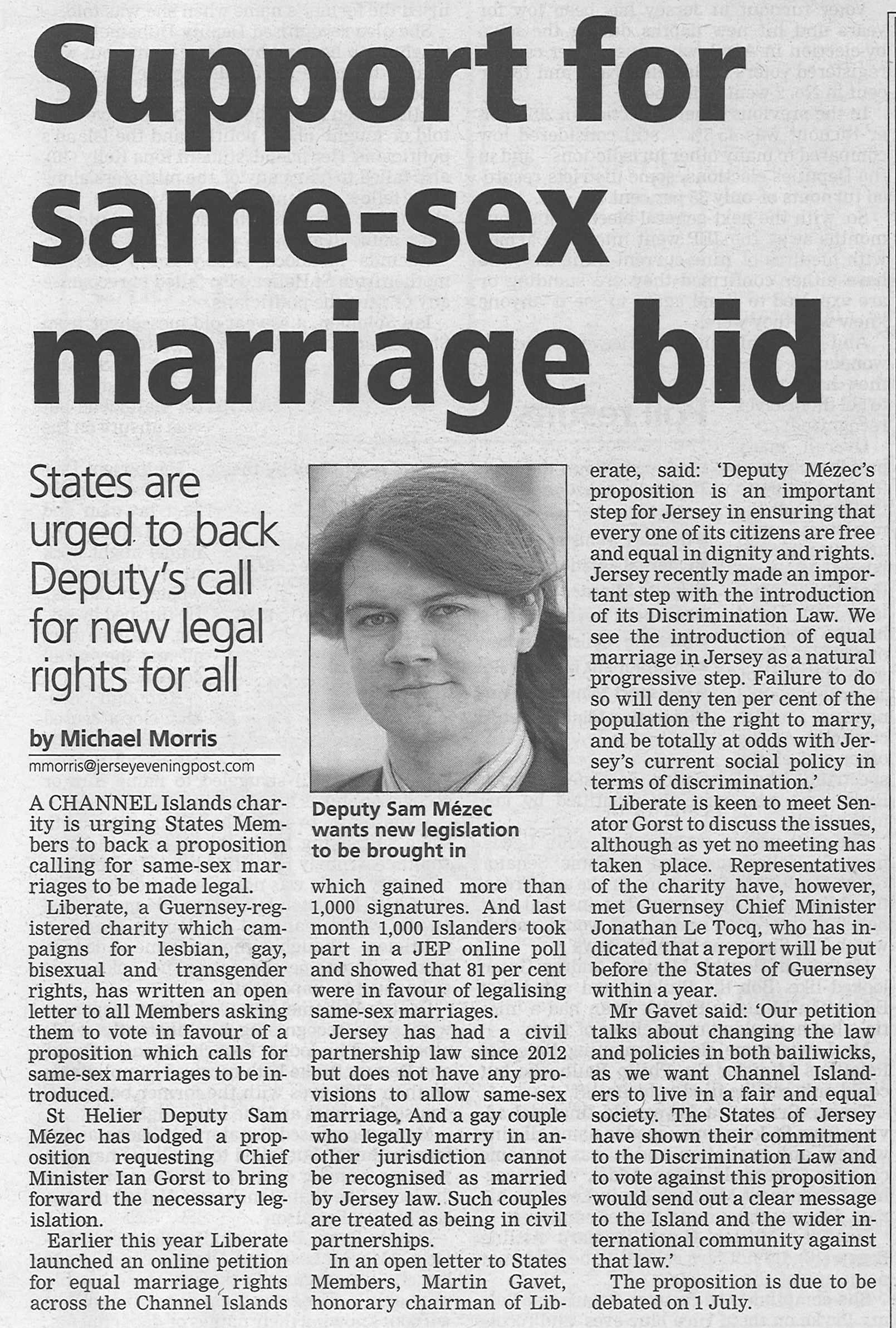
The JEP report from Tuesday 17 June 2014:

Liberate 170614

Trans* Jersey working with YES

Trans* Jersey is pleased to announce that it will be working with Jersey’s Youth Enquiry Service to develop a programme of talks, courses and/or workshops that can be taken into schools or youth clubs on the subject of gender, sexuality and sexual health.

The Youth Enquiry Service (YES) first opened in 2008. As well as offering a drop-in service for young people YES also provides one-to-one counselling as well as online advice on a broad range of issues.

YES was developed by the Youth Service in partnership with the Jersey Youth Trust. It was created to support young people aged 14 – 25 with any issue that affects them.

YES works with young people on any issue, for example, homelessness, benefits, advocacy work, crime, education, parenting, leaving care, drugs & alcohol, issues around sexuality, emotional health, relationships, sexual health and rights & responsibilities.

YES believe young people have a right to quality information, advice and counselling services. You can find them at La Motte St Centre, next door to the Social Security building.

If you or a young family member is questioning their gender or sexuality, YES run a confidential and discreet service that includes one-to-one sessions and/or group meetings with other young people where you can talk about similar issues. To find out more about the work of YES on this subject, click on the logo below.

youth_yes

An open letter to our trans partner

I am the wife of a trans woman who transitioned during our marriage. I am writing this to support partners as there are significant areas in common for us all but each of our paths on this journey may be very different. I also write to the trans person and just hope you both talk to each other. We want to keep our marriages intact.

There is no clear cut care pathway for partners here so do not be afraid to seek help and counselling. This journey can’t be done alone. Local GPs and counsellors are not specialists, so the more we speak up the more awareness will be raised. This is not a life choice for either of us; something that took me years to understand. I still ask myself: ‘why me’?

I had advanced notice before we got engaged that my husband was cross dressing since childhood. She agonised over telling me but we still got married and have now been together for over 30 years and married for 27. The prognosis for staying together is much higher if surprises and shocks are limited. We decided never to have children and life is a lot less complicated. However, it was still a shock when my partner decided to transition and, before I could understand the implications, she was self-medicating secretly. I went through hell. Women are good listeners and can be sympathetic, but I don’t like dishonesty, hiding or deception. We can detect little signs, and you may think your partner is having an affair if female clothing is found in the house which does not belong to you.

Helen and Betty 1For the trans partner: please remember that this is like a bereavement but with no body and no funeral. If you are going to throw clothes from your previous gender away warn your partner and, perhaps, allow us to keep some sentimental items – even if just for a while, so we can grieve in our own time. Acknowledge this grieving process is just like any other, it HURTS!

Keep open channels of communication at all times and also agree to stop talking if it is getting too much. My counsellor suggested we have a password to use if this is happening, and we then agree to talk later at an agreed time. So far that works for us.

The trans person may be tempted to rush into transitioning (coming out, HRT, ‘real life experience’ and possibly surgery) because it is a lifelong desire to change gender. For the partner, it is a constant ‘in your face’ tornado of selfish wants that completely ignores and threatens the relationship. The effects of HRT on the mind and the body are visibly shocking and can be upsetting for the partner who knew another person intimately. Thankfully, there are now several good books out there and web sites. Bear in mind that by ‘outing’ yourself as being trans, you do the same to your partner and they may be concerned about what others think. The partner of a trans person may worry about peoples’ perceptions: are we a lesbian couple, sisters, sisters-in-law…?

Our particular relationship has been strong enough to overcome this. My partner first attempted a kind of dual life of living as a woman outside work many years ago, but this time around its permanent and that was a big adjustment for me. In transition we now tend to avoid the same haunts we frequented because waiting staff would recognize me and wonder if I have a new relationship as we sit at the same table ordering the same favourite meals. Even in places we have never been to, the ‘couple’ in us still comes out as we say ‘we’ the whole time when talking. I have to be very blunt here and say a part of our success is that my partner is completely convincing and I doubt if I would remain if she was not. Do not ‘carry the monkey’: other peoples’ reactions are their problem not yours. Who to tell and when is up to you. We have now told all our best friends and family, but my partner’s family proved to be the most negative.

For me this is not a linear process either. I have not gone smoothly from timid enquiry, anger, depression, thinking and reading to acceptance. Some days are better than others. Several times I revisit each emotion forwards and then backwards. This is where counselling helps. You are not alone. Also, bear in mind this is no-one’s fault so try not to blame when you are at your most angry to accuse. If you think that is easier said than done, I totally agree as I am guilty of doing that often – even now. I was quite shocked in one professional counselling session in the UK to be told I had in fact married a woman all along! To be told it was all to do with conception, what happens in the womb and the brain was earth shattering. Read, read and read. I have found it quite fascinating, painful and absorbing.

Having gone through more than a woman should for love, my partner wants a Gender Recognition Certificate. In 2014 with same sex marriage legal, the process is still unclear for married people where a partner transitions and, yet, retains the same legal rights. The irony that we already live as same sex couples after surgery is lost on them.

To end on a lighter note; there have been many fun moments, e.g. I now get to buy more clothes than before as she understands the need, but co-ordinating what to wear out can be a laugh. In the end love is more important than gender.

(Photograph is not of the post author but of Helen Boyd and her partner, Betty Crow. Helen is the author of She’s Not the Man I Married.)

Open letter to Jersey’s politicians on equal marriage

Why civil partnerships do not make for equal marriage

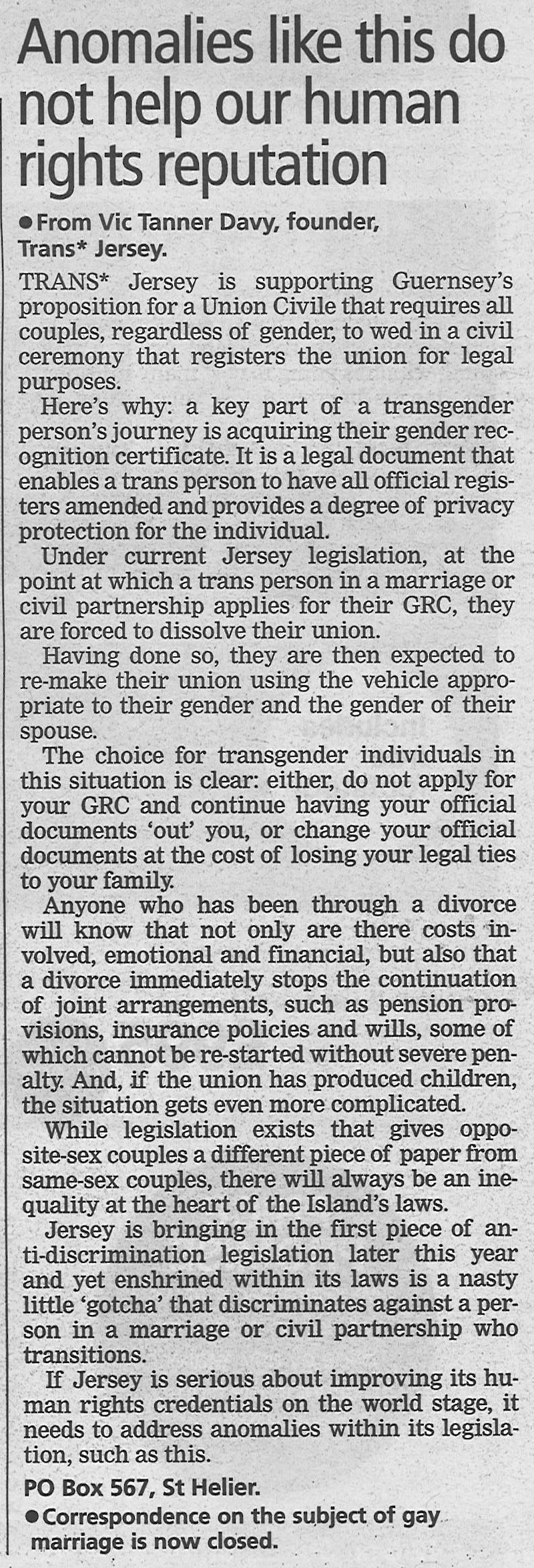
For those who think that they were made some kind of promise by the gay community that civil partnerships would be enough to ensure equality, I can confirm that no such promise was made by the trans community who have always known that civil partnerships do not provide true equality. As Jersey law stands, a person in a marriage or civil partnership who undergoes gender reassignment whilst still in that union is severely discriminated against.

A key part of a transgender person’s journey is acquiring their gender recognition certificate (”GRC”) after two years of living as their true gender. It is a legal document that means for all purposes you are the gender you present. It enables a trans person to have all legal documents amended, including their birth certificate. It also provides a degree of privacy protection for the trans person because it is an offence under the Gender Recogntion (Jersey) Law to “out” someone in possession of a GRC, for example, when giving an employment reference.

Under current Jersey legislation, at the point at which a trans person in a marriage or civil partnership applies for their GRC, they are forced to dissolve their union. Having done so, they are then expected to re-make their union using the vehicle appropriate to their gender and the gender of their spouse. The choice for transgender individuals in this situation is clear: either, do not apply for your GRC and continue having your official documents “out” you; or, change your official documents at the cost of losing your legal ties to your family.

Anyone who has been through a divorce will know that not only are there costs involved, emotional and financial, but also that a divorce immediately stops the continuation of joint arrangements, such as pension provisions, insurance policies and wills, some of which cannot be re-started without severe penalty. And, if the union has produced children, the situation gets even more complicated. I think that all sides of the marriage argument would agree that nobody should be forced to go through a divorce.

lesbian-marriageIn 2006, the International Commission of Jurists and the International Service for Human Rights developed a set of international legal principles on the application of international law to human rights violations based on sexual orientation and gender identity. These were called the Yogyakarta Principles and, whilst not adopted as an international standard, are cited by UN bodies and national courts, and many governments have made them a guiding tool for defining their policies in the matter. The European Commissioner for Human Rights has endorsed the Yogyakarta Principles, in particular principle number 3, and considers them an important tool for identifying the obligations of states to respect, protect and fulfil the human rights of all persons, regardless of their gender identity.

Yogyakarta Principle number 3 states that, “Each person’s self-defined sexual orientation and gender identity is integral to their personality and is one of the most basic aspects of self-determination, dignity and freedom… No status, such as marriage or parenthood, may be invoked as such to prevent the legal recognition of a person’s gender identity.”

Whilst legislation exists that gives opposite-sex couples a different piece of paper from same-sex couples, there will always be an inequality at the heart of the island’s laws. Jersey is proudly bringing in the first piece of anti-discrimination legislation later this year and, yet, enshrined within its laws is a nasty little “gotcha” that discriminates against a person in a marriage or civil partnership who transitions. If Jersey is serious about improving its human rights credentials on the world stage, it needs to adopt the Yogyakarta Principles as an internationally recognised model of best practice and address anomalies within its legislation such as this.

This is why Trans* Jersey is supporting Guernsey’s proposition for a Union Civile that requires all couples, regardless of gender, to wed in a civil ceremony that registers the union for legal purposes. Having done the legal part, couples who then wish to seek a church service aligned to their religious beliefs regarding marriage can do so. This solves the argument over the definition of marriage that exercises religious and secular groups, and it enables a transgender person to acquire their GRC and alter the gender on their Union Civile certificate without having to divorce. It is an elegantly simple solution to the problem and one that we hope Jersey will also propose, debate and pass.

The transition curve

John Fisher (Leicester University) is a well-respected business psychologist whose work on constructivist theory in relation to service provision organisations produced a model in 1999 of personal change, The Personal Transition Curve, which provides us with an analysis of how individuals deal with personal change. This was updated in 2012 and represents a development of The Change Curve, widely attributed to psychiatrist Elisabeth Kubler-Ross and her work on the process of bereavement and grief.

Business theory may seem a long way away from gender studies but it is relevant to us when we have to manage the effect that our transition has on those around us in order to retain our personal relationships intact during our transition. Understanding Fisher’s model and the phases that individuals go through when faced with change (of any sort) can help prepare us for the reactions of those closest to us around our transition. Take a look at Fisher’s 2012 model and there are probably some phases that seem familiar to you, reactions that you have witnessed in those around you to your news.
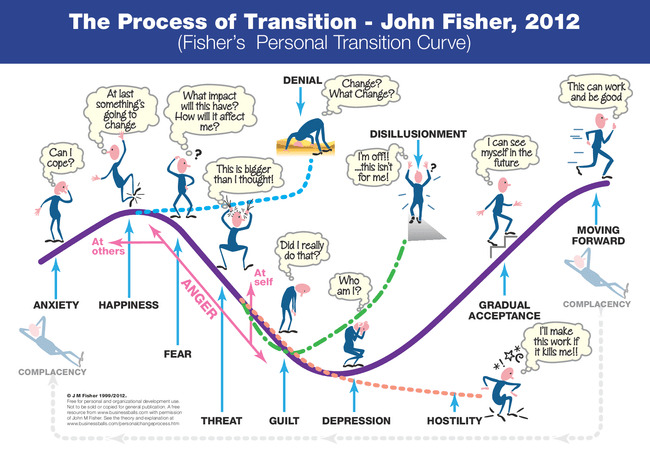
the-process-of-transition-fisher-s-personal-transition-curve-1Let’s examine the stages and apply them to the process of gender transitioning:

Anxiety
The awareness that events lie outside one’s range of understanding or control. Fisher believes the problem here is that individuals are unable to adequately picture the future. They do not have enough information to allow them to anticipate behaving in a different way within the new organisation. They are unsure how to adequately construe acting in the new work and social situations.

This is familiar to trans* people. The condition of gender dysphoria and the stages of treatment that trans* people have to go through is not well understood and outside most people’s experience. This breeds a fear of the unknown – what will life be like for the trans* person and what will life be like for those closest to the trans* person?

It is up to us to reassure those around us that we can see the future and it is going to be an improvement on the present. Using testimonies from trans* people who have gone before us, such as can be found on YouTube, can help those around us visualise our future.

Happiness
The awareness that one’s viewpoint is recognised and shared by others. The impact of this is twofold. At the basic level there is a feeling of relief that something is going to change and not continue as before. Whether the past is perceived positively or negatively, there is still a feeling of anticipation and even excitement at the possibility of improvement. On another level, there is the satisfaction of knowing that some of your thoughts about the old system were correct (generally, no matter how well we like the status quo, there is something that is unsatisfactory about it) and that something is going to be done about it.

Trans* individuals may recognise this phase as the moment when people say, “We always knew you weren’t like other children”, and then congratulate you on having the courage to recognise it in yourself.

Fisher says that the happiness phase is one of the more interesting phases and may be (almost) passed through without knowing. In this phase it is the “Thank goodness, something is happening at last” feeling coupled with the knowledge that, if we are lucky/involved/contribute, things can only get better.

Significantly for trans* individuals, if we can start interventions at this stage we can minimise the impact of the rest of the curve and virtually flatten the curve. By involving, informing, getting a “buy in” at this time we can help people move through the process. This is where availability of factual information can help maintain the “happy” feeling. Collect a number of different sources for your family to read that underline the positives of transitioning so they can choose the medium that suits them: health leaflets, transgender biographies, sympathetic documentaries and Internet resources. Encourage your friends and family to talk to you about your transition and accept any help that they may offer in order to involve them in your transition.

Fear
The awareness of an imminent incidental change in one’s core behavioural system. People will need to act in a different manner and this will have an impact on both their self-perception and on how others externally see them. However, in the main, they see little change in their normal interactions and believe they will be operating in much the same way, merely choosing a more appropriate, but new, action.

According to Frances (1999), fear and threat are the two key emotions that will cause us to resist change.

Threat
The awareness of an imminent comprehensive change in one’s core behavioural structures. Here people perceive a major change to what they believe to be their core identity or sense of self. The realisation that the change will have a fundamental impact on who we are, how we see ourselves and what is key in our personality to us as individuals. This is the shock of suddenly discovering you’re not who you thought you were! It is a radical alteration to our future choices and other people’s perception of us as individuals. Our old choices are no longer ones that will work. In many ways this is a “road to Damascus” type of life-changing experience. In this phase, people are unsure as to how they will be able to act/react in what is, potentially, a totally new and alien environment; one where the old rules no longer apply and there are no new ones established as yet.

It is key for trans* people to combat these two phases by being clear and concise about what is going to happen to them physically, what the timescale is for their transition, when others can expect to see physical changes, when others need to start using correct names and pronouns, etc. Being clear about what you need from those around you creates the new set of rules that friends and family can use to replace the old rules that no longer apply, giving them some stability.

Guilt
An awareness of a dislodgement of our self from our core self perception. We are not who we thought we were! Once the individual begins exploring their self-perception, how they acted/reacted in the past and looking at alternative interpretations they begin to re-define their sense of self. This, generally, involves identifying what are their core beliefs and how closely they have been to meeting them. Recognition of the inappropriateness of their previous actions and the implications for them as people can cause guilt as they realise the impact of their behaviour. Another of the emotions that may have an impact here is that of shame. This is the awareness of a negative change in someone else’s opinion of you from what you think it should be. The recognition of this shift in our own and other people’s opinion then leads into the next stage.

This is a particularly resonant phase for partners and parents who may have insisted, at various times in the trans* person’s life, that they dress or look a certain way. Depending on how forcefully this was done, those around the trans* person may feel guilty about this. It is up to us as trans* people to make it clear to those who love us that we understand they could not have known what they were doing and acknowledge that they meant well by their actions at that time.

Shame is one of the most destructive emotions for trans* people, when our family and friends feel ashamed of us because they receive, or think they will receive, negative opinions about us from others. Being out and proud of ourselves can help those closest to us to see that the world, by and large, is accepting of trans* people. Recounting your positive experiences of telling people can also help persuade friends and family that there is nothing to be ashamed of.

Depression
The awareness that our past actions, behaviours and beliefs are incompatible with our core construct of our identity. The belief that our past actions mean we’re not a very nice person after all! This phase is characterised by a general lack of motivation and confusion. Individuals are uncertain as to what the future holds and how they can fit into the future “world”. Their representations are inappropriate and the resultant undermining of their core sense of self leaves them adrift with no sense of identity and no clear vision of how to operate.

For trans* people this often manifests itself with declarations from friends and family that we are no longer who they thought we were or that everything they thought they knew about us was a lie. This, of course, is untrue. We need to remind them of all the things that have not changed about us. Gender is only one aspect of a person, it is not the whole. Undertaking activities with your friends and family that you have always done together can be a way to remind them that you haven’t changed and there are still lots of things about your relationship that are familiar.

Gradual acceptance
Here we begin to make sense of our environment and of our place within the change. In effect, we are beginning to get some validation of our thoughts and actions and can see that where we are going is right. We are at the start of managing our control over the change, making sense of the “what” and “why” and seeing some successes in how we interact – there is a light at the end of the tunnel! This links in with an increasing level of self-confidence and an awareness of the goodness of fit of the self in one’s core role structure, i.e. we feel good that we are doing the right things in the right way.

Moving forward
In this stage, we are starting to exert more control, make more things happen in a positive sense and are getting our sense of self back. We know who we are again and are starting to feel comfortable that we are acting in line with our convictions, beliefs, etc and making the right choices. In this phase we are, again, experimenting within our environment more actively and effectively.

Complacency
It has also been suggested that there is also actually a final (and/or initial stage) of complacency (King 2007). Here people have survived the change, rationalised the events, incorporated them into their new construct system and got used to the new reality. This is where we feel that we have, once again, moved into our comfort zone and that we will not encounter any event that is either outside our construct system (or world view) or that we can’t incorporate into it with ease. We know the right decisions and can predict future events with a high degree of certainty. These people are subsequently laid back, not really interested in what’s going on around them and coasting through the job almost oblivious to what is actually happening around them. They are, again, operating well within their comfort zone and, in some respects, can’t see what all the fuss has been about. Even though the process may have been quite traumatic for them at the time!

Annoying though this may be, especially if you have had to invest time in supporting them through the transition curve, don’t allow yourself to get angry at their denial of the effort it has taken to reach this level of acceptance of your transition. Just be grateful that they are there!

Now, let’s look at some of the ways that the transition curve can get derailed into negative emotions that go nowhere:

Denial
This stage is defined by a lack of acceptance of any change and denies that there will be any impact on the individual. People keep acting as if the change has not happened, using old practices and processes and ignoring evidence or information contrary to their belief systems. In many ways when we are faced with a problem, or situation, we don’t want, or one that we believe is too challenging to our sense of self we constrict or narrow our range of construction. In this way we eliminate the problem from our awareness. The “head in the sand” syndrome: if I can’t see it, or acknowledge it then it doesn’t exist!

This one is horribly familiar to lots of trans* people. The constant use of old pronouns and old names is a classic example of where a person is in denial about your transition. Be patient with this one. Listen to them and attempt to understand where they are at that moment. Timing is important when managing change so don’t try to move them onto the next stage before they are ready for it. You will be ahead on them on the transition curve so you will know when the time is right to move the discussion on.

You have to listen to them and attempt to understand where they are at that moment. – See more at: http://www.practical-management-skills.com/change-management-theories.html#sthash.R1FUxL3w.dpuf
You have to listen to them and attempt to understand where they are at that moment. – See more at: http://www.practical-management-skills.com/change-management-theories.html#sthash.R1FUxL3w.dpu

Anger
Fisher came to recognise over time that there seemed to be some anger associated with moving through the transition curve, especially in the earlier stages as people start to recognise the wider implications of change. This is not always present as it seems to be dependent on the amount of control people feel they have over the overall process. The focus of the anger also changes over time. In the first instance, for those where change is forced on them, the anger appears to be directed outward at other people. They are blamed for the situation and for causing stress to the individual. However, as time progresses and the implications grow greater for the individual, the anger moves inwards and there is a danger that this drives us into the guilt and depression stages. We become angry at ourselves for not knowing better and/or allowing the situation to escalate outside our control.

A lot of trans* people experience the anger of their friends and family at the changes being forced on them by the transition. Unfortunately, this anger frequently is directed at the trans* person rather than at the situation that those closest to us find themselves in. This is unfair but, if we understand why it is happening, we can recognise it for what it is and work through it. Hurtful and insulting remarks may be said in the heat of anger. We must try not to get angry ourselves and reply in kind but, instead, realise that they are not meant personally. They are a natural reaction to a situation that is out of an individual’s control.

Disillusionment
The awareness that your values, beliefs and goals are incompatible with those of the organisation. The pitfalls associated with this phase are that the employee becomes unmotivated, unfocused and increasingly dissatisfied and gradually withdraws their labour, either mentally (by just “going through the motions”, doing the bare minimum, actively undermining the change by criticising/complaining) or physically by resigning.

The undermining, criticising, and withdrawal of support may be familiar to trans* people. Often this happens to a friend or family member who has previously seemed supportive of our transition. One way to re-engage them with your transition is to ask their opinion about an aspect of transitioning in order to involve them in the process again. It could be something as minor as asking them to go shopping with you for some new clothes and taking their advice on what might suit you, or it could be a more significant involvement such as asking them to help plan your travel and accommodation for a hospital trip.

Hostility
The continued effort to validate social predictions that have already proved to be a failure. The problem here is that individuals continue to operate processes that have repeatedly failed to achieve a successful outcome and are no longer part of the new process or are surplus to the new way of working. The new processes are ignored at best and actively undermined at worst.

It is possible that some people in your life are not able to move forward and get stuck in the stages of denial, disillusionment or hostility. You may not be able to help everyone move through the change process, despite your best efforts. If this happens, your time might be better spent working with those who are moving through the curve and see your transition as a positive thing. These people can act as “champions” and may,in the long run, support those stuck in denial, disillusionment or hostility to reach the same view.

Summary
It can be seen from the transition curve that it is important for an individual to understand the impact that the change will have on their own personal construct systems, and for them to be able to work through the implications for their self-perception. Any change, no matter how small, has the potential to impact on an individual and may generate conflict between existing values and beliefs and anticipated altered ones.

To help people move through the transition effectively we need to understand their perception of the past, present and future. What is their past experience of change and how has it impacted on them, how did they cope, what will they be losing as part of the change and what will they be gaining? Our goal is to help make the transition as effective and painless as possible. By providing education, information, and support we can help people transition through the curve and emerge on the other side. Trans* Jersey has posted a page of change management tools that may help you manage your transition and the acceptance of those around you. Also, you may want to read around the subject of mechanisms for coping with change. There’s a good primer here from Mind Tools.

Each person will experience transition through the curve at slightly different speeds. Much of the speed of transition will depend on the individual’s self-perception, locus of control, and other past experiences, and how these all combine to create their anticipation of future events. The more positively you see the outcome, the more control you have (or believe you have) over both the process and the final result, the less difficult and negative a journey you have.

You can find out more about John Fisher’s process of personal transition here where the model’s history is discussed.