The gender pyramind

This is Trans* Jersey’s patented gender pyramid that explains how sex and gender are related.

Sex is at the top of pyramid because it has the smallest number of possible variations and is, therefore, the narrowest. It is also the least significant factor in all of this – although those who struggle with the issue of transgenderism would have you believe it is the most important. It is shown as either blue or pink – male or female. (We know blue and pink are a cliché, but had we used yellow and green, you would have had to remember that men were yellow and women were green, so we went with the accepted norm!) Currently, it is impossible to completely change your sex. You can go some way towards altering physical/cosmetic aspects, but no male can yet have a functioning uterus and ovaries implanted, and no female can yet have functioning testes implanted.

The middle layer of the pyramid is your gender identity. It represents where you feel you fit on the spectrum and how you would like to be perceived by the world. We’ve called this being a man or a woman. It is not quite as deeply embedded as sex and there is a greater blurring of the line between blue and pink on the pyramid.

The third layer of the pyramid we have called gender expression. By this, we mean the way that an individual is received by the world. Do they act, react, dress, in a more feminine or masculine way? It is the most fluid of all the layers, with a spectrum of pink to blue on which an individual may fall at any point.
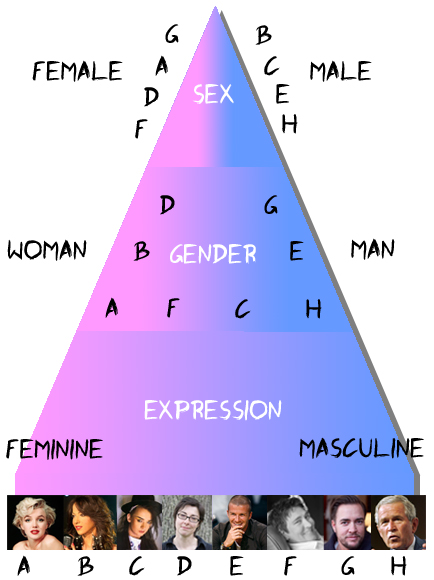
Gender pyramidSo, let’s take a look at some famous faces and start a debate! We’ve selected Marilyn Monroe (A) and George W Bush (H) as polar opposites on the feminine-masculine scale. There is no doubt in the mind of the onlooker that their presentation, gender, and sex are aligned.

Moving in from them on the scale, we have selected Sharon Cohen (B) and Ian Harvie (G). Sharon is a glamorous, curvaceous brunette who won Eurovision in 1998. There is no doubt that she is a very feminine woman, but she was born male. Ian is a bearded, stand-up comedian who grew up in a rural mountain town in Maine. He is a masculine man, but he was born female. They are both transsexual.

Next on the scale are singers George O’Dowd (C) and k.d. Lang (F). When both singers first appeared on the music scene the fact that their presentation was at odds with their gender and sex caused confusion for the public at large. However, just because society was confused, it doesn’t mean that they are, and so cannot be considered transgender. As far as we are aware, they identify happily as homosexual, which by definition means George is a man who loves men and k.d. is a woman who loves women. They both happen to be homosexual, but, as someone like Grayson Perry proves, this is not a given when you queer your gender.

Finally, converging in the centre are Sue Perkins (D) and David Beckham (E). Sitting centrally on the scale indicates a level of androgyny in a person’s presentation. There is no doubt about Sue and David’s gender or sex, unlike that of George and k.d. However, David’s light voice, attention to his grooming, and soft features are, arguably, more feminine characteristics. Sue’s career, style of dress, and forthright views are, arguably, more masculine characteristics. It’s a grey area, but that’s the point.

Take a moment and consider where you sit on the sex and gender scales. Are you a straight down the line Marilyn or George, or does your sex/gender line weave about a bit?


Gender: a human right

You have a right to present yourself in the way in which you wish to be received – so does a transgender person.

How proud of your presentation are you? Do you take time over it? Transgender people should be able to be proud of their presentation too.

How far would you go to protect your right to present yourself how you want? Transgender people all over the world put their lives at risk for this right.

In 2012, at least 265 trans people were murdered (data from 29 countries only). In only 13 cases has any arrest been made. In at least 2 cases the murders were committed by the police. In 56 cases the victim’s name has not been recorded. (Source: TDoR, 2012)

70% of children who are uncertain about their gender are subject to bullying, 88% of transgender employees experience discrimination or harassment in their workplace, and there has been a recent rise in hate crime against transgender people of 14%. (Source: UK Home Office report, 2011)

41% of transgender people in the United States have attempted to commit suicide; more than 25 times the rate of the general population, which is 1.6 percent. (Source: National Center for Transgender Equality and the National Gay and Lesbian Task Force, 2010)
woman makeup mirror
These statistics are alarming for the friends and families of people coming out as trans. We hasten to add that trans* people in Jersey do not tend to experience bullying, discrimination or harassment on the same scale as elsewhere. Britain has a much better track record than most countries regarding crimes against LGBT people. Surrounding yourself with educated people who understand the importance of tolerance and diversity in a civilised society can also help to minimise a trans* person’s exposure to discriminatory behaviour.

What is gender?

Firstly, your gender is not the same as your sex. It seems obvious but it is so deeply embedded in all of us that most people don’t think about it and use the terms interchangeably. According to the OED, sex is “either of the two main categories (male and female) into which humans and most other living things are divided on the basis of their reproductive functions”. A look at the reproductive organs or chromosomes of an animal will scientifically prove what sex they are. (There are a number of rare and specialist medical conditions where this is not the case. They are called intersex conditions, sometimes wrongly termed “disorders of sexual development” (DSDs), and occur before birth.) The OED defines gender as “the state of being male or female (typically used with reference to social and cultural differences rather than biological ones)”. There are two parts to gender: how you perceive yourself, i.e. man or woman, and how society receives your gender presentation, i.e. masculine or feminine. The genderbreadman (below) calls this your gender identity and your gender expression. To find out whether someone is a man or a woman, you have to ask them. Where sex is a physical state, gender is a mental state. It is about how you feel. Do you feel like a man or a woman? The answer to this question will, of course, be informed by the individual’s definition of what a man and a woman are, their life experiences, the society in which they live, etc. To decide what someone’s gender expression is you simply look at the way that an individual presents themselves to the world. Do they act, react, dress, in a more feminine or masculine way? This is all about society’s definition of what constitutes masculine/feminine behaviour and it changes as one moves around the world through other countries, tribes, and cultures. For a man to wear a skirt in Edinburgh is acceptable masculine behaviour but may not be so in Chelsea! It is about how an individual conforms to society’s norms for masculine/feminine behaviour, or chooses not to conform, and how other members of that society receive that individual’s presentation. genderbread So, to recap: Sex is biological – male or female Gender is psychological – man or woman Presentation or expression is an external representation of sex and/or gender – masculine or feminine Gender is how you would like to be perceived but, crucially, it is also how society receives your expression of that.

Glossary

Acquired gender: see Recognised Gender below. A legal/bureaucractic term used to distinguish between the gender someone was assigned at birth and the gender they feel themselves to be. Not widely used in the trans* community because of its implication that a trans* person “acquires” their gender, rather than has always been of that gender.

Assigned gender: see Acquired Gender above. Again, not widely used in the trans* community because of its implication that a trans* person can have their gender “assigned” to them by a third party, rather than has always been of that gender.

Androgynous: the gender expression of a person who has both masculine and feminine characteristics.

Bigender: a person who tends to flexibly shift between the gender behaviour typically associated with men and women depending on context.

Cis or cisgender: a person whose gender conforms to their birth sex, i.e. a male who identifies as a man or a female who identifies as a woman. The opposite of transgender.

Drag (queen or king): this refers to an actor or actress who dresses as the opposite sex for the purposes of entertainment. Not related to being trans*.

FtM or F2M: see Transman below.

Gender dysphoria: the medical term for the feeling that a trans* person has that their biological sex is not aligned with their gender identity.

Gender expression or presentation: the gender that a person appears to other people to be, selected from a spectrum of genders.

Gender identity: the gender that a person feels themselves to be, selected from a spectrum of genders.

Genderqueer: anyone with a gender identity that is non-binary, i.e. not man or woman. Genderqueer people may identify as one or more of the following: having an overlap of, or indefinite lines between, gender identity and sexual and romantic orientation; two or more genders (bigender, trigender, pangender); without a gender (nongendered, genderless, agender, neutrois); moving between genders or with a fluctuating gender identity (genderfluid); third gender or other-gendered. It also includes those who do not place a name to their gender.

Gender recognition certificate or GRC: a document certifying that for all purposes a transgender person is to be treated as the gender they feel themselves to be. In the UK, the document enables a transgender person to amend their birth certificate if they so choose.

Gender variance: a term for the feeling that a trans* person has that their biological sex is not aligned with their gender identity.

dictionary_1633840cMtF or M2F: see Transwoman below.

Passing: the act of successfully being accepted by society as the gender that you wish to present.

Pronouns: he/him/his/his, she/her/her/hers, they/them/their/theirs. There are a range of gender neutral pronouns that have been suggested over the years. A list can be found here. Never ever use “it” when referring to a trans* person.

Recognised gender: An acceptable term used to distinguish between the gender someone was assigned at birth and the gender they feel themselves to be. The term acknowledges not only the trans person’s recognition of their “true” gender but also society’s recognition of their gender.

Sex: the biological or chromosomal sex of a person, as distinct from their gender identity or expression.

Sex-change: out-dated and unacceptable now.

She-male: unacceptable description of a transwoman.

Stealth: the condition whereby a trans* individual passes so completely that they elect not to reveal they are trans*.

Tranny: unacceptable shortened form of the word transgender or transsexual.

Trans: an acceptable shortened form of the word transgender or transsexual.

Trans*: this has replaced trans in recent years. It has been adopted by the trans* community to encompass more groups than just transsexual and transgender individuals. Trans* encompasses anyone whose gender is non-binary or fluid, i.e. androgynous, bigender, genderqueer and some intersex people.

Transgender: a term that describes someone whose gender identity is not aligned with their biological/chromosomal sex. Transgender should never be used as a noun (“I met a transgender today”). Transgender is an adjective (“I met a transgender person today”). Transgendered is also not correct (“I met a transgendered person today”) and should be avoided.

Transsexual: a term that used to be used to distinguish between someone who had undergone gender reassignment surgery and someone who had not (who would have been referred to as transgender). This has fallen out of favour as people have begun to emphasise the plurality of gender rather than accepting it as binary.

Transition: the process that a transgender person undertakes to move from being accepted as one gender to being accepted as the gender they feel themselves to be. It usually includes hormone therapy to make physical changes to the body but may or may not involve surgical procedures.

Transman: a transgender person born female but living as a man. Synonymous with the term FtM (female to male).

Transwoman: a transgender person born male but living as a woman. Synonymous with the term MtF (male to female).

MtF finance

Even if you take the publicly funded healthcare route to manage your transition, the costs are higher for trans* islanders than for trans* individuals in the UK because we have to travel to see the specialists who can assist us to transition.

For those transwomen with island medical insurance policies, you will find that they specifically do not cover any treatment relating to gender reassignment.

Below are some of the costs that you will need to fund whichever transition route you follow:

Travel
Flights to the UK for consultations with your therapist. You will need to budget for more than one visit. Depending on how your therapy goes, you could be visiting regularly for a while. The cheapest flights from Jersey to the UK are on the Gatwick route so take this into consideration when you and your GP select your therapist. Your appointment should only be an hour so you should be able to get over and back in the day. Also, remember to budget for the Gatwick Express into London and transport in London.

GP visits
You will need to visit your GP more regularly than usual to keep them updated on progress, to ask for referrals, to have bloods taken to check your hormone levels and to ask their advice on a range of issues. Budget for about one every two months during your first two years of transition.

Change of name
The costs given below are approximate. They may change.

Deed poll prepared by Jersey advocate and sworn in Royal Court: £435
New driving licence: £40
New passport: £75
Passport photographs: £5

See the change of name page for more details.

Devices for passing
Some transwomen like to use breastforms and gaffs to assist them in passing. Breastforms start at about £30 and can go up as high as £750 for realistic skin tone, shape and nipples. Gaffs are around £35-£50. For more information about suppliers see the help page.

financeBelow are some of the costs that are optional depending on how you manage your transition. You may elect to go completely private, completely public through the States and NHS systems, or do a mixture of private and public:

Gender therapy
For those who wish to see a gender therapist privately in the UK, an hour’s consultation will cost about £200.

Hormone therapy
For those who wish to see an endocrinologist privately in Jersey, an hour’s consultation will cost about £280.

Surgery
Bottom surgery (GRS): costs vary depending on the surgical procedure being undertaken. Orchiectomy: £3,000 app. Cosmetic genital reconstruction surgery without vaginoplasty: £9,500 app. Vaginoplasty (penile inversion): £10,800 app. Colon vaginoplasty: £13,000 app.

If you go abroad for surgery, don’t forget to add in the travel, accommodation and food costs. For GRS, for example, you won’t be able to fly for a least a week afterwards, which means a hotel bill. Full recovery time is six to twelve weeks.

Top surgery: costs vary depending on the type of breast augmentation surgery being undertaken. There are two types of implant commonly used. However, you can expect to pay between £3,500 and £5,000.
Facial feminising surgery: costs vary depending on the surgery being undertaken, and there is a large range of procedures you can have done. You can pay anything from £1,000 for a minor procedure to £10,000 for a full facelift.

See the surgery page for more details of MtF surgery.

Funding
The truth is transitioning costs the trans* individual and, because it is still seen as a choice rather than a necessity, especially by insurers, there is little financial help available.

Try to put away £100 of your salary every month into a transition fund or hold a ‘transition fund’ event where friends and family show their support by donating as much or as little as they want without embarrassment.

Don’t fund your transition through credit cards or pay-day loans. These are the worst ways to borrow money as the interest rates are so high. If you need to borrow, talk to your bank about a loan. Trans* Jersey has contacted NatWest bank in Jersey and they have confirmed that they would do a personal loan for treatment or surgery and that anyone who approached them would be treated sensitively and with discretion. Criteria for the loan would be the standard requirements, ie. any person wanting a loan will need to bank with NatWest for 6 months, have a regular income mandated to the account and be able to afford the loan. Anyone seeking this sort of facility can contact Tanya Nerac, Assistant Relationship Manager, in the first instance who is one of our trans* allies.

MtF hormones

In order to transition from male to female, transwomen usually take two hormones for the rest of their lives: estrogen and progesterone.Pre-orchidectomy surgery they may also take anti-androgens. This is usually the first medical step on your transition journey after changing your name and possibly living as your preferred gender for a short period of time. The Looking Glass Society has detailed information about HRT (hormone replacement therapy) here.

Your GP or doctor in Jersey is very unlikely to prescribe hormone replacement therapy for you. They will not have the necessary skills in gender care to decide whether hormone therapy is right for you. It will be your gender therapist who will start you on HRT. However, they will need to send their recommendation for your starting dose and the subsequent progress of your dose to your GP or psychiatrist in Jersey. Depending on what versions of HRT you have been advised to take, your GP or psychiatrist may be able to write the prescription for you or arrange for you to see the island’s endocrinologist, either privately or through the health service, who will write the prescription for you. HRT is a life-long commitment for transwomen and the cost of the hormones is not cheap so the majority of transwomen will elect to get help through the States of Jersey’s usual free prescription scheme.

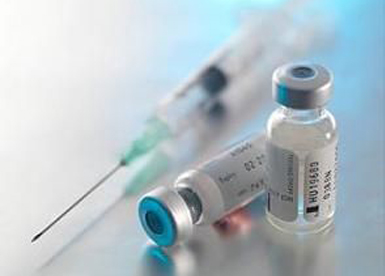
hormonesThere are a number of different forms in which HRT can be administered (injections, subcutaneous slow-release capsules, gels, patches) and Jersey offers most of the versions available. However, not all the versions of HRT delivery are on the GPs’ list of drugs they can prescribe. The States of Jersey’s endocrinologist has access to a much wider range of HRT delivery methods through the hospital’s pharmacy.

Whether your GP or psychiatrist can prescribe the type of HRT delivery recommended by your gender therapist or not, they will almost inevitably have to refer you to Jersey’s endocrinologist at some point for monitoring of your hormone levels. The endocrinologist is based at Overdale in the Department of Metabolic Medicine or can be seen privately at the Little Grove, St Lawrence.

Even if you start by seeing the endocrinologist privately, you can ask them to refer you through the health service for all follow ups. You will need to see the endocrinologist regularly, at least to begin with. The endocrinologist will monitor your blood to ensure that the hormones are being absorbed and used correctly by your system. They will ask you to ask your GP to arrange to take blood tests as needed. The results will be returned to the endocrinologist who will then discuss them with you. Once your hormone levels are steady and at the same level as a natal female, your visits to the endocrinologist will become less frequent and you need only telephone their office to request repeat prescriptions, which are sent down to the hospital pharmacy where they are filled within about 48 hours and where you collect them.

Press and media advice

Trans* Jersey is very happy to answer questions from the press and media about trans* issues. All enquiries should be addressed to: admin@transjersey.org in the first instance.

The following interview is a parody of typical media interviews with transgender people, with Janet Mock asking Alicia Menendez – who is cisgender – many of the same questions she routinely has to deal with as a transgender woman. The video highlights the way that even trans-welcoming media personalities can objectify and dehumanize their transgender guests by focusing on their bodies and medical histories. Take 5 minutes to watch it here before you plan your interview questions.

Janet-MockResources for journalists reporting on transgender issues or interviewing transgender people from –

Trans Media Watch
GLAAD
Press Complaints Commission

Resources for transgender interviewees from –

Trans Media Watch
Massachusetts Transgender Political Coalition